

19 june 2026
Truck scales are used by businesses in dozens of industries where accurate accounting, shipment control, and efficient logistics matter. They help prevent overloading, reduce losses, and provide reliable data on the movement of raw materials and finished products. That’s why truck scales have become an essential part of production and logistics processes at many businesses.
In this article, we’ll look at where weighing systems are used, what tasks they solve, and how to choose the right equipment for your specific business. We’ll also cover the features of using scales in different fields and find out which solutions work best for particular operating conditions.
Truck scales are a specialized system for determining the mass of vehicles, with or without cargo. This equipment is used for commercial accounting and logistics process control.
The main elements of the system are the platform, load cells, and the weighing terminal. As the vehicle drives on, the load is transferred to the sensors, and the electronics process the signal and display the result on a screen or in the software.
Modern systems allow you to obtain:
Weighing can be carried out in static mode or while the vehicle is moving. The data obtained is used to determine gross and net weight, control axle load, and generate reports.
Businesses need truck scales for more than just determining vehicle weight. In modern business, they’ve become an important tool for controlling material flow, helping maintain accurate records of raw materials, finished products, and shipments. The data collected is used to analyze business performance, generate reports, and automate many operations.
Another important task of a weighing system is preventing overloading. Weight control helps avoid fines, reduces the risk of premature vehicle wear, and ensures compliance with cargo transportation requirements. For companies handling large volumes of products daily, this means lower financial losses and more predictable costs.
In addition, modern weighing systems help optimize logistics. Automated accounting, integration with ERP and accounting software, fast document processing, and minimized human error all help speed up vehicle processing and improve the efficiency of all production and warehouse processes.
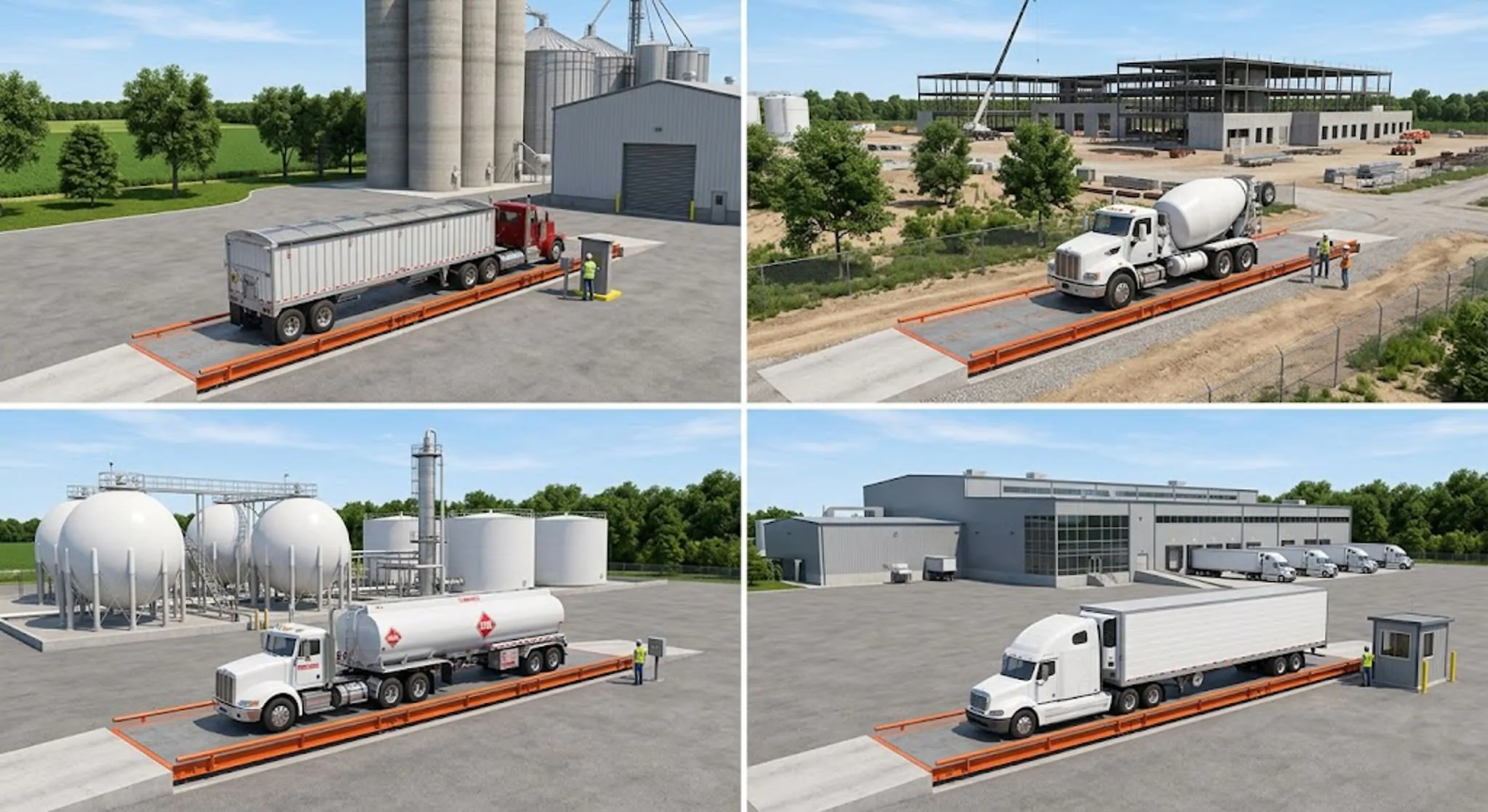
Weighing equipment is used across virtually every branch of industry and logistics.
For agricultural businesses, truck scales are one of the main control tools.
They are used for:
KVZ offers solutions for farms, grain elevators, and agricultural holdings, taking into account traffic intensity and the required load capacity.
In this field, controlling bulk materials is essential.
Weighing systems make it possible to track:
Special attention is paid to the loading of dump trucks, since operations take place under heavy load conditions.
Logistics companies use truck scales to control vehicle flow and track cargo. Automation helps reduce vehicle processing time and increase the facility’s throughput.
In this field, weighing is used for:
Weighing systems help track waste and monitor transportation volumes.
At manufacturing facilities, weighing systems help control incoming raw materials and the shipment of finished products. Many modern systems support integration with ERP, 1C, and other accounting software.
Operating specifics depend on the nature of the business.
| Industry | Main Task | Vehicle Type | Scale Requirements |
|---|---|---|---|
| Agriculture | Harvest tracking | Grain trucks, tractors | Long platform, high accuracy |
| Quarries | Bulk material control | Dump trucks | Increased durability |
| Logistics | Shipment tracking | Trucks | High throughput |
| Manufacturing | Raw material control | Semi-trucks, specialized vehicles | Automation and integration |
| Utilities | Waste tracking | Garbage trucks | Durability in harsh conditions |
Different businesses require different weighing system designs. The choice depends on traffic intensity, available space, operating conditions, and automation requirements. Modern truck scales can differ in their installation method, mobility, and the level of additional system integration.
Read more on this topic: Types of Truck Scales: Designs and Applications
Stationary scales are the most common solution for businesses with constant vehicle traffic. They are installed on a prepared foundation and are designed for many years of intensive use. Such systems are used at grain elevators, production sites, quarries, logistics centers, and industrial facilities. Platform length can range from 6 to 24 meters, with load capacity often reaching 60–100 tons.
Mobile weighing systems are used at temporary sites or in conditions where the equipment needs to be relocated periodically. They are used in construction, road maintenance, seasonal work, and remote production sites. The advantage of these solutions is quick installation and the ability to move them to a new location without significant costs.
Based on installation method, scales are divided into above-ground and below-ground (pit-type) models. Above-ground structures are mounted on the surface and require ramps for vehicles to drive on. They are simpler to maintain and provide convenient access to the load cells and cable lines.
Below-ground scales are installed flush with the road surface and take up less space. This solution is especially relevant for businesses with limited space or complex traffic patterns. However, maintaining these structures requires greater attention to drainage systems and pit cleanliness.
A separate category consists of automated weighing systems that can operate with virtually no operator involvement. They are equipped with software, license plate recognition systems, RFID identification, video surveillance, traffic lights, and duplicate display boards. These solutions reduce vehicle processing time and minimize human error.
Choosing weighing equipment shouldn’t be based on maximum load capacity alone. It’s important to consider the business’s specifics, operational intensity, vehicle type, and operating conditions. A solution that works well for a grain elevator may prove ineffective for a quarry or logistics center. That’s why, before designing a weighing system, it’s standard practice to analyze the actual production processes and the business’s growth prospects.
Vehicle Traffic Intensity
One of the key criteria is the number of vehicles passing through the weighing station per day. Standard solutions are sufficient for small businesses, while large production sites, grain elevators, or logistics centers require scales with high throughput and automation capabilities. If vehicle traffic is heavy, it’s worth planning for integration with license plate recognition systems, video recording, and software for fast data processing.
One of the key criteria is the number of vehicles passing through the weighing station per day. Standard solutions are sufficient for small businesses, while large production sites, grain elevators, or logistics centers require scales with high throughput and automation capabilities. If vehicle traffic is heavy, it’s worth planning for integration with license plate recognition systems, video recording, and software for fast data processing.
The nature of the materials being transported also affects the choice of design. For agriculture, long platforms for weighing road trains and grain trucks are important, while for quarries and mining operations, increased structural durability and resistance to heavy loads become the priority. When working with scrap metal, bulk materials, or waste, the effects of dust, moisture, and aggressive environments must be taken into account.
For commercial accounting, reading stability and compliance with metrological requirements are especially important. If weighing results are used for settlements with suppliers and customers, it’s important to choose equipment with reliable load cells and modern electronics. It’s also worth planning for integration with ERP and other accounting systems, which will help automate document workflow and increase transparency across all operations.
Weather conditions, soil characteristics, humidity levels, and dust at the site directly affect the durability of a weighing system. For open sites with heavy loads, it’s important to correctly choose the platform type, load cell protection, and foundation design. That’s why many businesses prefer custom design, which allows the scales to be adapted to specific operating conditions and ensures stable operation for many years.
Implementing weighing systems has a positive impact on a business’s economics.
Key benefits include:
Kyiv Weighing Plant not only manufactures equipment but also handles its setup and integration with the business’s information systems.
Choosing a weighing system is a long-term investment, so mistakes at this stage can lead to additional costs, downtime, and the need for modernization within just a few years.
Problems most often arise from:
Truck scales have long since become more than just a weighing tool – they’re an important business management instrument. They help control material flow, reduce costs, and improve business efficiency.
To get the most out of your investment, it’s important to consider your industry’s specifics, operating conditions, and your company’s growth prospects. KVZ specialists will help you select the optimal solution and handle the design, installation, and setup of a weighing system tailored to your business’s specific needs.
