Installation of hoppers on strain gauges.
Modernization of bunker scales on strain gauge sensors.
The largest companies in Ukraine

![[:ru]Логотип Бетон от Ковальской[:en]Logo Concrete from Kovalskaya[:ua]Логотип Бетон від Ковальської[:]](https://kvz.in.ua/wp-content/webp-express/webp-images/uploads/2019/09/beton-ot-kovalskoy-logo.png.webp)
![[:ru]Логотип ДТЭК [:en]DTEK logo[:ua]Логотип ДТЕК [:]](https://kvz.in.ua/wp-content/webp-express/webp-images/uploads/2019/09/Dtek-logo.png.webp)
![[:ru]Логотип ДПЗК [:en]DPZK logo[:ua]Логотип ДПЗК [:]](https://kvz.in.ua/wp-content/webp-express/webp-images/uploads/2019/09/dpzk-logo.png.webp)
![[:ru]Логотип Метинвест[:en]Metinvest logo[:ua]Логотип Метінвест[:]](https://kvz.in.ua/wp-content/webp-express/webp-images/uploads/2019/09/metinvest-logo.png.webp)
![[:ru]Логотип Агропроммаш[:en]Agroprommash logo[:ua]Логотип Агропроммаш[:]](https://kvz.in.ua/wp-content/webp-express/webp-images/uploads/2019/09/agroprommah-logo.png.webp)
![[:ru]Логотип Укрпроммаш[:en]Ukrprommash logo[:ua]Логотип Укрпроммаш[:]](https://kvz.in.ua/wp-content/webp-express/webp-images/uploads/2019/09/ukrprommash-logo.png.webp)
![[:ru]Логотип KRP [:en]KRP logo[:ua]Логотип KRP [:]](https://kvz.in.ua/wp-content/webp-express/webp-images/uploads/2019/09/krp-logo.png.webp)
![[:ru]Логотип КБВ[:en]KBV logo[:ua]Логотип КБВ[:]](https://kvz.in.ua/wp-content/webp-express/webp-images/uploads/2019/09/kbv-logo.png.webp)
![[:ru]Логотип Интерпайп[:en]Intertpipe logo[:ua]Логотип Інтерпайп[:]](https://kvz.in.ua/wp-content/webp-express/webp-images/uploads/2019/09/interpipe-logo.png.webp)
![[:ru]Логотип Grain Alliance [:en]Grain Alliance logo[:ua]Логотип Grain Alliance [:]](https://kvz.in.ua/wp-content/webp-express/webp-images/uploads/2019/09/grain-alliance-logo.png.webp)
![[:ru]Логотип ФДЛГ[:en]FDLG logo[:ua]Логотип ФДЛГ[:]](https://kvz.in.ua/wp-content/webp-express/webp-images/uploads/2019/09/fdlg-logo.png.webp)
![[:ru]Логотип Альтком[:en]Altkom logo[:ua]Логотип Альтком[:]](https://kvz.in.ua/wp-content/webp-express/webp-images/uploads/2019/09/altkom-logo.png.webp)
![[:ru]Логотип Экомит[:en]Ecomeat logo[:ua]Логотип Екоміт[:]](https://kvz.in.ua/wp-content/webp-express/webp-images/uploads/2019/09/ecomeat-logo.png.webp)
![[:ru]Логотип Совлюш-буд[:en]Sevlyushbud logo[:ua]Логотип Севлюшбуд[:]](https://kvz.in.ua/wp-content/webp-express/webp-images/uploads/2021/02/sevlyushbud-1.png.webp)


It is necessary to limit the displacement of the hopper in the plane

A device/mechanism is required to prevent the hopper from tipping over
| Highest weight limit | 1-100 Т |
| Smallest weight limit | 10-400 Kg |
| Discreteness of reference and the price of calibration d = e | 0.5-50 Kg |
| Accuracy class according to DSTU EN 45501 | Average |
| Margins of error with normalized external influences, not more than | 0.2-0.5% of the LEL |
| Duration of the weighing cycle (measurement time), no more | 15 s |
| Time scales exit to the set operating mode, no more | 15 minutes |
| Electric power supply of scales | Single-phase current from 187 to 242 V and a frequency of 50 ± 1 Hz |
| Type of climatic modification, degree of protection according to DSTU EN 60529 | - for strain gauges - IP67 (IP68) - for digital measuring instrument - IP54 (IP65) |
| Ambient temperature range | - for strain gauges - from - 35 ºС to +65 ºС - for a digital measuring device - from 0 ºС to +40 ºС |
| Full average service life, not less | 10 years |
Hopper scales – are containers mounted on supports in the form of weight strain gauges that are connected to a weight indicator that shows the weight of the material in the hopper and can be connected to the control system ( dosing).
Hopper scales are designed for metering, weighing and dosing of materials, substances (both bulk and liquid) passing through the hopper.
Bunker scales are used in enterprises: agricultural, food, mining, chemical, energy, construction, processing, metallurgy, engineering and other industries.
According to the requirements of regulatory documentation, namely the standard DSTU EN 45501: 2011, the balance belongs to the middle accuracy class.

Welts LLC,
Mikhailovka-Rubezhevka

Cryogenservice LLC,
Zaporizhia

Agrofirm Puzikovskaya LLC,
Puzikovo

LLC Ukraine,
Ovsyuki

Novye produkty LLC,
Zhashkov

PE Grivas,
Nezhin

The presence of full-time construction, installation, service teams ensures compliance with deadlines Manufacture

Scales fully comply with the requirements of the standard DSTU EN

A full set of permits for all necessary types of work guarantees turnkey work

Own production and direct supply of components guarantees the best price on the market

Extreme Operation

Availability and development of special automated accounting systems

Certificate type verification HERMES BTA

State building license

Construction license, list of types of work

Qualification certificate of certain types of work

Explosion Examination Certificate HERMES BTA
| Built-in nodes (with or without balancing mechanism) | 3-10 pcs |
|
Strain gages: H8C-C3-0.5-10t-4B BM8D-C3-0.5-10t-6B H2F-C2-1-50t HM9A / B-C3-10 / 40t-16B HM14H1-C3-10 / 50t BM14G-C3-10 / 40t ZEMIC USA Inc. | 3-10 pcs |
| Junction box JB06- .. , Corrugated cable (15m) | 1 PC |
|
Weight indicator: A12E, A12ЕSS + free software | 1 PC |
|
Weighing controller: C8, C602 | 1 PC |
* the delivery set may change as agreed with the Customer
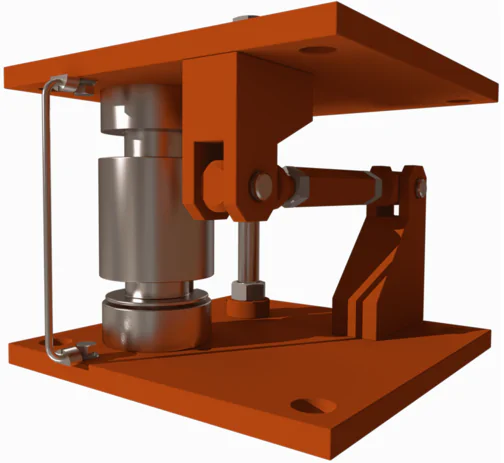
Mounting units play an important role for hopper scales. The installation unit (mounting modules) is a device that ensures the correct installation of the strain gauge in the design of dispensers, bins. Depending on the type of load receptor and the selected type of strain gauge, as well as operating conditions, this method is selected installation of a strain gauge, which will provide:
- Accurate load transfer to the sensor;
- Reliability of installation;
- Protection against lateral and dynamic loads;
- Sufficient sensitivity;
- Minimal installation and commissioning time.
The design of the built-in assembly also provides for protection of the sensor from peak horizontal movements, rotation, tipping and other unwanted effects.
The accuracy of the weighing is influenced by the installation location (indoor or bunker scales installed outdoors). In the case of installing the scales on the street, the weather conditions will influence the weighing accuracy (strong wind “effect Sailing ”). Also, weighing accuracy is affected by strong vibration and the capacity loading method.
For each balance there is a maximum mass that they are able to measure. This maximum weight is called the maximum weight limit (or LEL for short). If you try to weigh a load heavier than the LEL, the device will most likely show either the wrong weight or an error message. To determine the LEL, the manufacturer needs information about the geometric parameters of the tank / tank and the gross mass of the system (tank mass + mass of material + external factors affecting the system), it is important that the sensors and mounting units are correctly selected.
The purchase of bunker scales involves the manufacture of built-in units for weight sensors, as well as the installation of your design on electronic sensors using the manufactured units. In addition to the installation of sensors, we make the connection of electronic components to the weighing terminal and configure the connection to the computer if this includes equipment, as well as checking the accuracy of weighing.
Tirsa Andrew Team Leader
