

19 june 2026
The weighing accuracy of freight vehicles depends not only on the equipment’s specifications, but also on how correctly it has been installed. That’s why owners of grain elevators, logistics complexes, quarries, and manufacturing facilities often look for information on how to prepare a site and avoid mistakes at the initial stage. KVZ specialists have prepared a guide on proper installation, site preparation, and the key factors that determine the durability of weighing systems.
Weighing accuracy, stable operation, and equipment service life are directly determined by the quality of installation. Mistakes during installation work or ignoring site-specific factors will negate all the advantages of even the most modern truck scales with high-quality load cells, robbing them of the accuracy they need.
Uneven load on the supports, foundation settling, or structural misalignment can cause the platform to tilt. As a result, measurement error increases, more frequent calibration becomes necessary, and individual components start operating under increased stress. This not only affects accounting accuracy but can also lead to additional repair costs and business downtime.
In addition, the quality of the work determines the equipment’s structural safety margin, which guarantees stable operation for many years. If the foundation is correctly calculated and the drainage system effectively removes moisture, the equipment better withstands heavy vehicle traffic, seasonal temperature changes, and constant loads. In this case, truck scales retain their performance characteristics for a long time and require minimal intervention during operation.
The installation method depends on the site’s characteristics, traffic intensity, and business requirements.
The above-ground option involves placing the platform above the surface level using ramps. This solution eliminates the need for complex structural elements and large-scale ground preparation, significantly simplifying the process. It’s convenient for sites where fast equipment startup is important.
Advantages:
The drawback is the need for extra space for vehicles to drive onto the platform.
This option involves installing the platform flush with the surrounding surface. It’s used at businesses with heavy vehicle traffic where preserving usable space is important.
The main advantage is convenient vehicle movement. Trucks can approach from different directions, which simplifies logistics. At the same time, below-ground truck scales require an effective drainage system and more complex construction work.
High-quality site preparation largely determines the equipment’s future operational stability and measurement accuracy. It’s at this stage that the site’s characteristics, soil properties, and traffic organization are taken into account.
It’s best to choose a level site with enough room for freight vehicles to maneuver when setting up a weighing system. The site’s geological characteristics are critically important, since the foundation’s design and service life depend directly on the soil’s strength and load-bearing capacity. In difficult conditions, additional engineering solutions may be needed to ensure structural stability even under heavy loads.
Drainage is another issue that can’t be ignored. Excess meltwater or rainwater is a direct threat to the foundation and can eventually cause dangerous settling of the entire structure.
Properly designed access roads are another critically important element. They’re needed so large trucks can maneuver freely, easily drive onto the scale, and safely drive off of it. Thoughtful site logistics help reduce weighing time and improve the business’s operational efficiency.
Installing truck scales involves several sequential stages, each of which affects the final result.
Every weighing system begins with engineering calculations, since it’s at this stage that the main characteristics of the future equipment are determined.
The design process always takes into account maximum loads, traffic intensity, vehicle types, and the site’s production specifics. Based on these parameters, the platform length, load capacity, and optimal weighing system configuration are selected. This stage also determines the installation location, traffic flow scheme, and the need for integration with accounting systems.
KVZ specialists perform individual calculations, which makes it possible to adapt the truck scales to specific operating conditions and, before construction even begins, estimate the future budget and avoid unforeseen costs.
The type of foundation is selected based on the scale’s design, soil conditions, and the business’s operating conditions. Different projects may use:
Concrete quality, proper reinforcement, and compliance with all design documentation requirements are essential. Special attention should be paid to allowing enough time for the concrete to cure. Moving on to the next steps too early risks foundation settling, misalignment, and equipment malfunctions. Further work is only permitted once the foundation has fully stabilized.
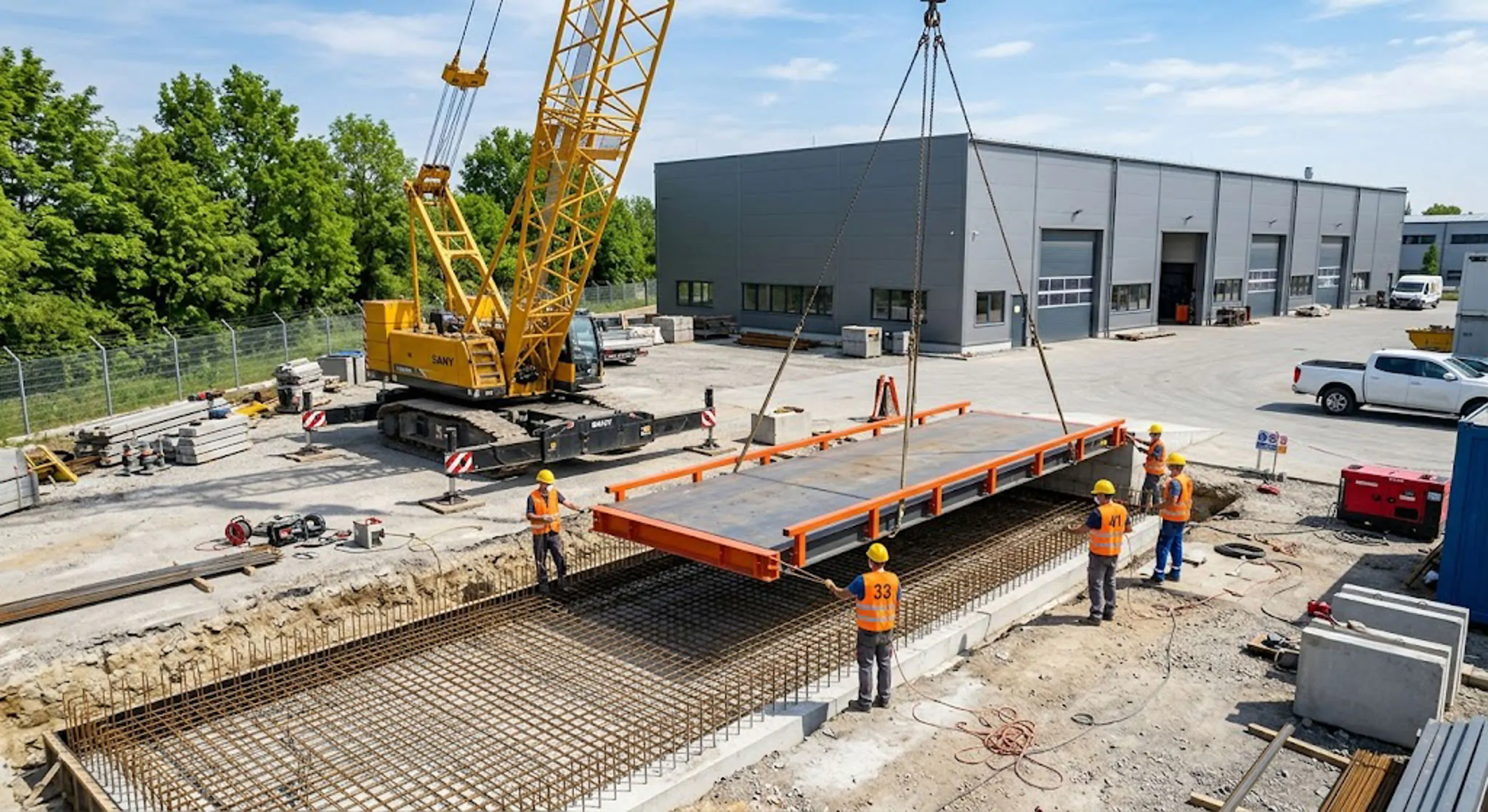
Once the foundation is ready, the steel frame is installed and the main elements of the weighing equipment are adjusted.
During installation, special attention is paid to the structure’s geometry and the correct leveling of the platform. Even the smallest misalignment or deviation can throw off the load cell system’s calibration and distort weighing results. That’s why every element is carefully checked against the design after installation. Strict adherence to the process guarantees that the platform will withstand extreme loads and operate reliably for years.
Load cells are a core component of the weighing system, as they convert mechanical pressure into an electrical signal. The accuracy and stability of the entire measurement system depend on how correctly they are installed.
After the sensors are installed, cable lines are laid, junction units are connected, and the operation of the entire chain is tested. It’s critically important to position each sensor correctly so that the load is distributed perfectly evenly between them.
The final stage is calibrating the weighing system. This makes it possible to achieve the required measurement accuracy and ensure stable equipment operation in various operating modes.
Electronic components are an essential part of modern truck scales, since they handle the collection, accurate processing, and transmission of data.
This is the stage at which the elements that turn the system into a full-fledged accounting and control tool are installed:
Truck scales can be easily synchronized with the overall automation and accounting system already in use at the client’s business.
Before being put into operation, the equipment always undergoes comprehensive testing. This confirms that all components are working correctly and that metrological readings meet standards. The final stage includes commissioning, test weighings, and calibrating the accuracy of the entire system. Specialists also check the electronics, signal transmission stability, and software integration. The weighing system is officially commissioned only after successfully passing all tests.
KVZ performs turnkey work, allowing the client to get a ready-to-use weighing system without having to involve multiple contractors.
Project timelines are determined by the design’s specifics and on-site conditions. Approximate timeframes can look like this:
| Stage | Duration |
| Design | 1–5 days |
| Foundation preparation | 2–4 weeks |
| Concrete curing | 21–28 days |
| Equipment installation | 1–3 days |
| Setup and testing | 1–2 days |
The speed of implementation is affected by the type of structure, weather conditions, and the complexity of automation.
Most problems arise from failing to follow proper procedures.
The most common mistakes are:
These shortcomings can cause truck scales to require more frequent maintenance and recalibration.
The final price depends on many factors.
The cost is influenced by:
The total amount usually includes design, foundation preparation, equipment installation, setup, and commissioning.
Choosing the right configuration is a smart way to save money. For example, you don’t need to pay extra for the longest truck scale model if a more compact one is enough for your needs.
To avoid delays, it’s best to prepare the site in advance.
Before work begins, it’s worth doing the following:
This approach helps get the truck scales up and running faster and avoids additional costs.
A system’s durability is ensured by a combination of measures – correct foundation design, proper installation, and precise calibration. Failing to meet technical requirements at the initial stages leads to significant financial costs for fixing defects during the equipment’s subsequent operation. That’s why it’s important to carry out all work professionally and comprehensively.
Kyiv Weighing Plant has experience implementing projects for the agricultural sector, logistics, and industry, providing truck scales with a full cycle of services – from design to commissioning. This ensures a predictable outcome and confidence in weighing accuracy from day one.
