


15 april 2020
Which sensors are better digital or analog primarily depends on the tasks that are planned to be solved with their help.
To understand the capabilities of each type of sensor and the range of tasks that can be solved with their help, let’s take a look at the main differences between the use of digital and analog load cells.
An analog signal is a carrier of information from the sensor to the weight terminal, but the digitized values appear only after analog-to-digital conversion in the weight terminal itself. Therefore, all non-informative signal distortions that occur in the strain gauge cable between the sensor and the weight terminal are added to the analog signal and introduce errors into the transmitted information from the sensor.
Modern strain gauge cables together with methods for processing analog signals (six-wire connection of sensors, filtering) reduce these errors, therefore, if the weight indicator is not more than 100 meters from the scales, then the effects of the above distortions can be neglected and the weighing results can be considered correct.
When using digital sensors, the signal is digitized directly in the sensor itself. Thus, in contrast to the analog system, we have a digital signal in the area from the sensor to the weight terminal. The noise immunity and noise immunity of the digital signal is significantly higher than the analog signal, which allows you to remove the weighing terminal from the direct installation site of the balance at a distance of up to 1000 m without loss of weighing accuracy.
We can conclude that digital sensors are the preferred solution for those tasks that require the removal of the weighing terminal from the place of installation of the scales more than 100m. And also in the case of being in close proximity to the scales of sources of interference and distortion (high-voltage lines, transformers)
Theoretically, you can change the digital sensor, and knowing certain calibration coefficients (information about the conversion characteristics from the accompanying documentation for the sensor), register them in the weight terminal. This is enough to restore the performance of the balance. The scales will work, aiming for the middle class of accuracy. But without calibrating the scales with a reference load, it is against the law to work on such scales (according to existing technical regulations and GOSTs). All numbers of sensors installed in the truck scales are recorded in the passport, in which the verifier puts his signature and seal, indicating that the scales correspond to the middle class of accuracy and are ready for use.
And when replacing any of the sensors, it is necessary to invite a metrologist (calibrator) with an exemplary load and re-calibrate the scales. And after that, make changes to the passport for the scales, writing there a new number of the installed sensor.
The opinion that digital sensors are more accurate than analog ones (or vice versa) is absolutely incorrect. The characteristics of the sensors are determined by the accuracy class. For analog and digital sensors of the same class, the accuracy will be the same. And it does not depend on the type of signal transmitted.
We all know that the fewer elements in the system, the less likely it will fail. The presence of an additional electronic board in the design of a digital sensor potentially impairs its reliability.
However, given the high quality of electronic components and modern analog-to-digital systems, it must be recognized that the reliability of analog and digital sensors is “approximately” equal, despite the fact that more electronic elements are used in digital sensors.
If we compare the cost of an analog and digital sensor of one manufacturer, then the cost of the latter will be higher.
We display the main differences between analog and digital load cells in the table.
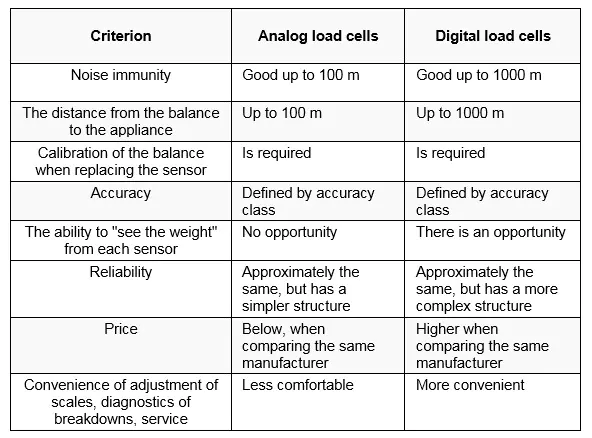
Total:
Of course, in terms of ease of diagnosis, configuration and maintenance, digital sensors are better and preferable to use. But it is better and more preferable to a greater extent for the manufacturer and repair and service organizations.
For consumers (buyers) of electronic scales, the obvious advantages of digital sensors can be associated with a range of tasks:
