


06 october 2019
As a rule, all the main cargo flows subject to accounting pass through truck scales. As a rule, the accuracy of these weights determines the basic economic indicators of the enterprise, including the level of so-called “non-technological” losses. In this article we will explain why it is necessary to use only the best weights. This is especially important during the financial and economic crisis, when everyone is trying to reduce unplanned expenses.
In recent years, in Ukraine, automobile scales began to be produced not only by several serious specialized enterprises, but also by hundreds of “skillful hands artels” created by random people. The trouble is that a large number of types of scales and their manufacturers give rise to an even greater number of problems in the field of metrology, service and control for consumers.
What is the difference between weights from the Kiev Weight Plant (KVZ), which is the most massive electronic truck scale in Ukraine, from artel scales made in haste by amateurs? The most amazing thing is that on paper – nothing! In the passport of “artel” scales, the same values of the calibration division price will be indicated, which determines their declared accuracy, average and warranty service life, etc. In addition, their price will be 20 … 30% lower.
In actual use, they will be less accurate and reliable, and, consequently, as a result, will cost you many times more! We will be able to verify this together by performing a series of simple arithmetic operations. But first, some information from the field of metrology.
Scales, like any other method of measurement, have an error. The error of the scales is the difference between their readings and the actual value of the mass of the load is solved. As a rule, the error of good truck scales in the temperature range from minus 30 to +40 is ± 0.1 … 0.3%. Since in order to weigh the mass of cargo (net) of cargo by a car, we must weigh the car twice – loaded (Gross) and empty (TAR) – the limit
the total error of the result will be approximately 2 times higher.
For the simplicity of our calculations, we assume that good truck scales allow you to determine the “NET” mass of the goods transported by the car with an accuracy of ± 0.1%. Thus, the weighing error of, for example, 20 tons of grain will be ± 20 kg. If 200 cars with grain were decided on the elevator during the day, the total mass of which is 4000 tons, then the total error (uncertainty) of the result will be ± 4 tons! We emphasize that while we are talking about weighing on the best modern electronic truck scales!
Thanks to the use of high-precision and reliable certified load cells, a rigid design of the load-lifting platform, a high-quality weighing terminal, and a well-designed and constructed foundation is not deformed, the Δ error of the BTA scales remains unchanged and stable over time. Every day, month and year in summer and winter, day and night, in rain and clear weather, the uncertainty of weighing 20 tons of cargo on these
the balance does not exceed the limit value of ± 20 kg.
Another thing is “artel” weights (Fig. 2). Savings on the components of the scales – sensors and electronics, on the quantity and quality of the metal used to weld the load receiving platform, as well as on construction and foundation works, lead to the fact that when the ambient temperature changes, the weights begin to “lie” in 90% of cases. Metrology says that there is an additional (temperature) systematic error in weighing. According to our research on the metrological characteristics of cheap sensors, temperature can increase the error by a factor of three!
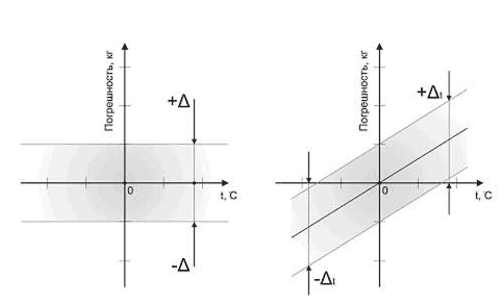
Figure 1. Change in the limiting error of weighing with a change in ambient temperature
As a result of the construction of an insufficiently rigid foundation, an additional random error may occur. Subsequently, it can progress – a weak loading platform is finally deformed by the ever-increasing number of weighted vehicles, and a slightly rigid foundation gives rise to subsidence.
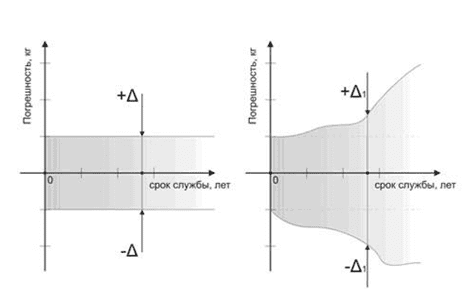
Figure 2. Change in the marginal error of weighing during subsidence of the foundation and permanent deformation of the load receiving platform
And this is not a nightmare, but, unfortunately, a fairly common picture observed by customers who decided to save 10 … 30 thousand hryvnias when buying weights and about the same amount when building the foundation. Let us now evaluate the benefit that the client receives when buying mass scales in Ukraine, time-tested automobile scales called “Hermes”.
Continuing the topic of grain, we calculate the cost of those losses during weighing that we did not suffer as a result of using the best weights. Let a ton of grain cost 6,000 UAH, and the actual error of the “artel weights” in operation is not 3 … 8 times, but only 2 times higher than in the KVZ scales. When weighing the same 200 cars per day, the “loss” (loss) “not suffered” by you will amount to
4t x 2 x 6000 UAH = 48000 hryvnia / day!
Thus, the difference in the cost of “artel” and professional scales, taking into account the construction of the normal recommended KVZ foundation, is compensated for after a maximum of 1 month:
Further, weights give only profit and will pay off completely in 2 … 3 months. But it is only on the grain! If we calculate the payback of the scales on more expensive goods, such as flour, non-ferrous scrap metal, meat products, etc., then the results will be simply amazing!
KVZ scales can work even without an operator – a weigher in automatic mode. This is important in today’s time of crisis, when all owners are optimizing the number of staff to reduce production costs. In this case, the weights are equipped with traffic lights, barriers and video cameras, as well as equipped with special software.
Counting paper bills at the cash desk of our company, we often repeat this operation twice to make sure that the amount is calculated correctly. Weighing raw materials or finished products on the scales, we actually also value our money. So use only the best truck scales for this!
Made in Ukraine – it sounds proud!
