

23 july 2026
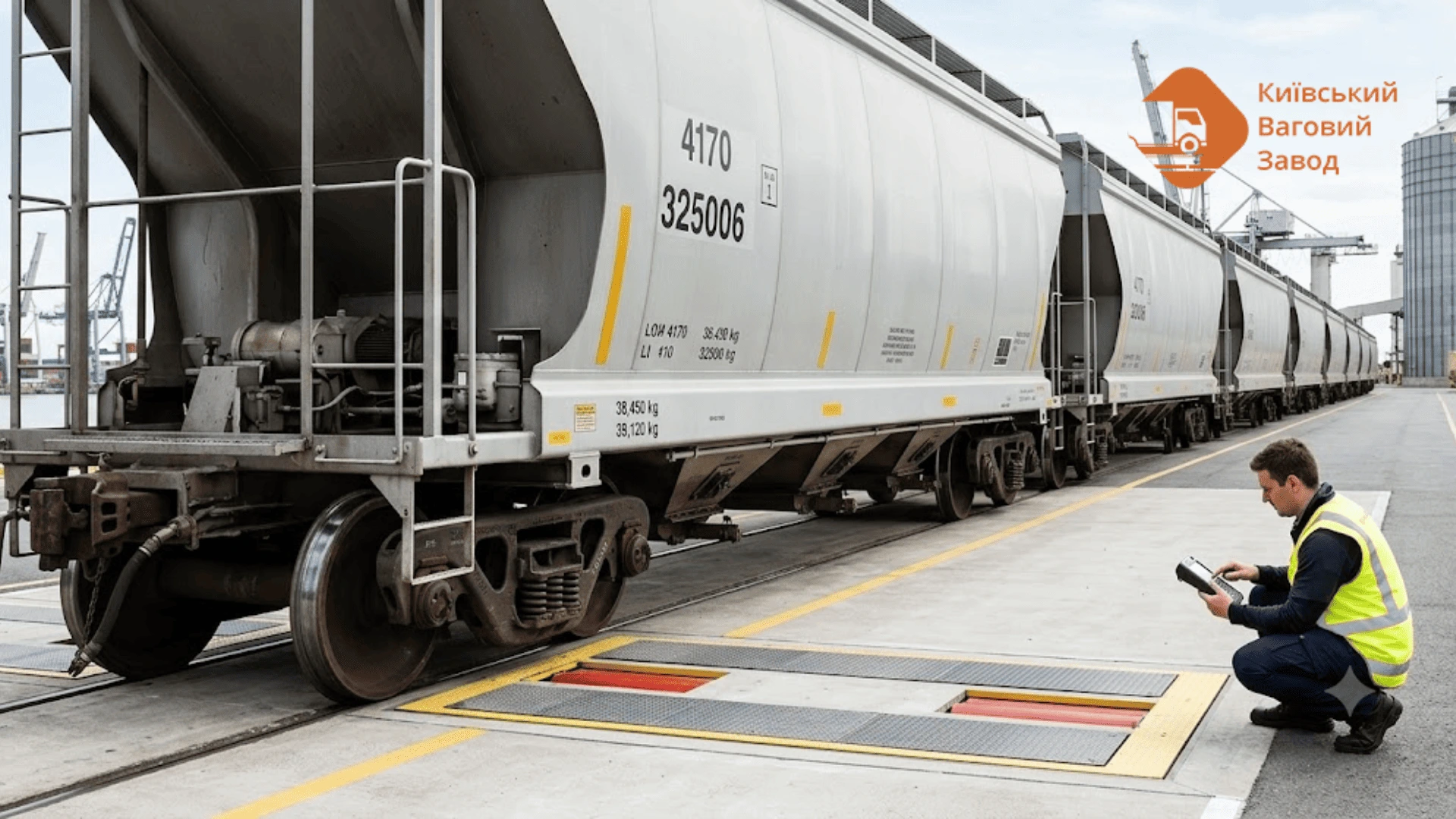
Railway scales are specialized equipment designed to determine the weight of railway wagons (loaded or empty) for commercial or technological accounting purposes. They are an important part of the infrastructure of enterprises that transport significant volumes of cargo by rail. The scales make it possible to control loads, automate logistics, and ensure data accuracy during receiving and dispatch operations.
When choosing railway scales, it is important to consider not only their cost and maximum weighing capacity, but also the type of structure, number of platforms, weighing method, and installation conditions. These parameters determine measurement accuracy, operating speed, and future maintenance costs.
In this article, KVZ experts will explain the key types of structures, installation site requirements, and design considerations that ensure the long-term and efficient operation of the weighing system.
Choosing railway scales always begins with an analysis of the operating conditions. Even models with similar technical characteristics may perform differently at different enterprises depending on traffic intensity, cargo type, and the specific characteristics of the railway track.
One of the key criteria is the weighing mode. If wagons can be moved onto the platform one at a time and stopped for weighing, static weighing is a suitable option. It provides high accuracy and is widely used for commercial accounting. However, if entire train consists regularly pass over the scales and the speed of operations is critical, systems that support dynamic weighing should be considered. In this case, the weight is determined while the train is moving at a speed of 3 to 15 km/h without the need to uncouple the wagons, which significantly reduces cargo flow processing time.
The type of wagons used at the enterprise is equally important. For example, wagons with different bogie wheelbases, lengths, and numbers of axles may be used to transport grain, coal, ore, metal products, or petroleum products. Therefore, the design and dimensions of the weighing platforms are selected individually for the specific rolling stock fleet.
Special attention should also be paid to the intensity of enterprise operations. If several dozen wagons pass through the weighing system per day, the performance requirements will be completely different from those of an enterprise where hundreds of wagons are weighed daily. In the latter case, process automation, integration with accounting systems, automatic wagon number recognition, and electronic document generation become particularly important.
The conditions of the future installation site must also be assessed before selecting the equipment. Important factors include the geological characteristics of the site, the condition of the existing railway track, the possibility of constructing a foundation or using a foundationless structure, as well as the enterprise’s future development plans. If freight turnover is expected to increase in the coming years, it is advisable to provide for the possibility of upgrading the weighing system from the outset.
The comprehensive approach used by KVZ specialists when analyzing the specific characteristics of an enterprise helps avoid situations where the equipment formally meets technical requirements but fails to provide the required performance or requires costly reconstruction after only a few years of operation.
The structure of railway scales determines the installation method, site preparation requirements, project implementation cost, and future operating conditions. Modern manufacturers offer several structural solutions, each with its own area of application. When making a choice, it is important to consider not only the project budget but also geological conditions, the intensity of enterprise operations, the feasibility of construction work, and the characteristics of the railway infrastructure.
Foundation-mounted scales are installed on a specially prepared concrete foundation that ensures high rigidity and stability of the entire system. This solution is most commonly used at large industrial enterprises with continuous freight traffic, where the equipment is designed for many years of intensive operation.
The main advantages of foundation-mounted scales are their durability, resistance to heavy loads, and minimal influence of external factors on measurement accuracy. A reliable foundation reduces the risk of deformation caused by seasonal ground changes or significant dynamic loads.
At the same time, implementation of such a project requires a greater volume of construction work, careful foundation preparation, and longer commissioning times for the weighing system.
This solution combines high reliability with the ability to reduce construction time. Instead of a monolithic foundation, prefabricated reinforced concrete elements are used, which significantly speed up installation and reduce the amount of work required directly at the site.
KVZ specialists recommend this option for enterprises where it is important to commission the weighing system as quickly as possible without lengthy construction work. When properly designed, such structures provide the required accuracy and can be successfully used at enterprises in various industries.
Foundationless structures are installed on a specially prepared base without constructing a massive concrete foundation. This makes it possible to reduce installation time, the amount of excavation work, and the overall cost of the preparatory stage.
However, such solutions impose higher requirements on the quality of the base. Insufficient soil compaction or failure to follow the preparation technology may negatively affect the stability of the weighing system and measurement accuracy.
Foundationless scales are often used at enterprises where a project needs to be implemented quickly or where there are restrictions on large-scale construction work. At the same time, the decision to install them should only be made after assessing the geological conditions of the site.
| Structure Type | Main Advantages | Where They Are Used |
| Foundation-mounted | Maximum stability, durability, high accuracy | Large industrial enterprises, intensive freight traffic |
| Precast reinforced concrete | Faster installation, less construction work | Enterprises where reducing project implementation time is important |
| Foundationless | Lower preparation costs, quick installation | Sites with suitable geological conditions and moderate loads where large-scale construction work is not possible |
Regardless of the selected structure, the efficiency of the weighing system largely depends on the quality of its design, installation, and equipment setup. This is why many enterprises prefer manufacturers that provide a full range of services — from analyzing operating conditions and developing the project to manufacturing the scales, installation, commissioning, and subsequent maintenance. KVZ also follows this approach, which ensures coordinated operation of all system components and reduces risks during equipment commissioning.
The number of weighing platforms is one of the key parameters when designing railway scales. It determines not only the weighing method but also measurement accuracy, system performance, and the ability to work with different types of rolling stock.
Single-platform scales have one load-receiving platform 4–5.5 meters long, onto which individual axles or wagon bogies are positioned sequentially during weighing. After receiving the data, the system automatically calculates the total weight of the wagon.
Such scales are compact and involve relatively low installation costs. They can be an effective solution for enterprises with low freight turnover or limited installation space. At the same time, the weighing process takes longer, and the accuracy of the results largely depends on the correct positioning of the wagon on the platform and compliance with the weighing procedure.
Two-platform structures are currently considered one of the most common solutions for industrial enterprises. During weighing, one wagon bogie is positioned on each platform simultaneously, making it possible to obtain results faster and reduce the influence of additional factors on measurement accuracy.
Depending on the length of the platforms and the distance between them, such scales can be adapted to different types of wagons. This principle is used in many modern static-dynamic weighing systems that can weigh both individual wagons and entire train consists without uncoupling them. As a result, two-platform systems effectively combine high performance, accuracy, and economic efficiency.
Three-platform scales are used much less frequently and mainly at enterprises with specific requirements for organizing the weighing process. An additional platform makes it possible to work with certain types of wagons or implement special technological schemes when the number of weighing operations needs to be minimized.
Due to their greater structural length, more complex installation, and higher cost, such solutions are appropriate only when their use is justified by the specific characteristics of the production process or rolling stock.
KVZ engineers note that the number of platforms alone does not determine the quality of a weighing system. It is much more important that its design corresponds to the wagon wheelbase, weighing mode, and intensity of enterprise operations. This is why specialists at the Kyiv Weighing Plant design platforms individually (three-, four-, and five-platform configurations), combining their lengths and relative positioning to work with different types of wagons. This approach makes it possible to achieve high measurement accuracy and ensure stable system operation over a long period of time.
Even the most advanced weighing equipment will not provide the required accuracy if installation site requirements are not taken into account. Therefore, site preparation is one of the most critical stages of project implementation and directly affects the reliability of the weighing system.
Railway track gauges used in Ukraine include 1,520 mm and 1,435 mm. Railway scales are installed on a straight section of railway track. This is necessary to ensure that the load from the wagon is transferred evenly to the weighing platforms and that measurement results are not distorted by misalignment or additional lateral forces.
The technical condition of the track itself is also very important. Worn rails, an unstable rail-and-sleeper structure, or defects in the base can negatively affect both weighing accuracy and equipment durability.
The base must withstand significant static and dynamic loads without subsidence or deformation. For foundation-mounted structures, a concrete foundation is constructed in accordance with the project documentation, while for foundationless models, particular attention is paid to compacting the base and properly preparing the crushed-stone layer.
Before installation begins, engineering and geological surveys are often carried out to assess the bearing capacity of the soil and select the optimal structural solution. This approach helps prevent subsidence of the weighing platforms during operation and maintain measurement accuracy throughout the entire service life of the equipment.
One of the most common causes of premature wear of weighing systems is water accumulation in the installation area. Excessive moisture can gradually damage the base, accelerate corrosion of metal components, and complicate maintenance.
To prevent these problems, KVZ engineers provide for an effective drainage system and organized removal of surface water and groundwater at the design stage. This is especially important for enterprises that handle bulk materials, where dust, raw material residues, and other contaminants may accumulate together with moisture.
For stable operation of the weighing system, it is important to ensure unobstructed movement of rolling stock across the scales. Approach tracks must comply with project requirements, and sufficient space must be provided around the equipment for maintenance, repairs, and metrological verification.
If the weighing system will operate automatically, it is advisable to provide locations for additional equipment during the installation stage, including:
KVZ engineers take all technical details into account before the installation of the scales begins, which helps minimize risks during subsequent operation.
Properly selected and installed railway scales can operate reliably for decades. However, the many years of experience of KVZ specialists show that problems most often arise during the design stage, when decisions are made without taking into account actual operating conditions or the enterprise’s future development prospects.
One of the most common mistakes is choosing a structure based solely on cost. For example, foundationless scales may appear to be a more economical option, but not every site allows them to be installed without the risk of base subsidence. As a result, the initial savings may be outweighed by additional repair or modernization costs.
Another common mistake is selecting the wrong number of weighing platforms. If the structure does not correspond to the characteristics of the rolling stock or the weighing mode, this can lead to reduced productivity, more complicated staff operations, and increased wagon processing time.
Proper preparation of the installation site is equally important. Insufficient base compaction, errors in foundation construction, or the absence of effective drainage negatively affect structural stability and may influence measurement accuracy.
Enterprises also sometimes underestimate the importance of automation. If the weighing system does not support integration with accounting systems, automatic wagon number recognition, or data transmission to the enterprise’s information system, difficulties with production scaling and process digitalization may arise in the future.
Choosing railway scales is always an individual task. There is no universal structure that will operate equally effectively at a grain elevator, metallurgical plant, mining enterprise, or logistics terminal. Therefore, the entire range of technical and production factors must be considered during the design stage.
Kyiv Weighing Plant offers customers modern railway scales that can be equipped with systems for automatically determining the direction of train movement, wagon number recognition, video surveillance, bogie load monitoring, and integration with the enterprise’s software. Such solutions not only speed up the weighing process but also minimize the influence of human factors and improve the quality of accounting.
Comprehensive project support, in-house production, the ability to adapt the structure to specific operating conditions, professional installation, and maintenance are no less important than the characteristics of the scales themselves. KVZ provides a full project implementation cycle — from design and manufacturing to equipment commissioning and subsequent technical support.
A properly selected weighing system becomes a long-term investment that helps automate accounting, improve the efficiency of logistics processes, and ensure consistently accurate weighing for many years.
There is no single definitive answer. The choice depends on the geological conditions of the site, operating intensity, project budget, and the time required for installation work. After analyzing the future operating conditions, it is possible to determine which structure will be most effective specifically for your enterprise.
The number of platforms is selected depending on the types of wagons, weighing method, and required performance of the weighing system. For most industrial enterprises, two-platform systems are the optimal solution; however, the final decision is made after a technical analysis of the project.
In many cases, yes, provided that the condition of the track meets technical requirements and allows installation to be carried out in accordance with the project documentation. Before work begins, specialists inspect the site and determine the required scope of preparatory work.
The project implementation time depends on the type of structure, the complexity of site preparation, and the scope of construction work. Preparing the base usually takes the most time, while equipment installation and commissioning are completed considerably faster.
Yes. Modern weighing systems can automatically transmit weighing results to the enterprise’s information systems, support wagon number recognition, video surveillance, train movement monitoring, and report generation without manual data entry.
Accuracy is influenced by the design of the weighing system, the quality of the load cells, correct installation, the condition of the railway track, base preparation, regular maintenance, and timely metrological verification of the equipment.
In many cases, yes. We have an established approval process with JSC “Ukrzaliznytsia”:
Depending on the equipment design, the weighing electronics, software, and load cells can be upgraded, or additional automation systems can be installed. This makes it possible to expand the functionality of the weighing system without completely replacing it.
