

23 july 2026
Before discussing the characteristics of weighing scales or their accuracy, it is important to understand which component actually performs the measurement. It is the load cell that converts mechanical load into an electrical signal, which is then processed by the weighing indicator. The stability of readings, equipment durability, and accuracy of commercial weighing depend on its design, accuracy class, and proper selection. Therefore, whether the system involves truck scales, rail scales, platform scales, or hopper scales, selecting the right load cell requires just as much attention as choosing the weighing platform itself.
A load cell, also known as a strain gauge load cell, is the primary measuring element of a weighing system that converts mechanical force from a load into an electrical signal. After being processed by a weighing indicator or controller, this signal is displayed as a weight value. Simply put, it is the load cell that “senses” the weight of the load, while the other system components only receive, analyze, and display the resulting information.
Modern load cells are used in virtually all industrial weighing systems. They are incorporated into truck scales, rail scales, platform scales, hopper scales, crane scales, and batching scales, and are used at grain elevators, manufacturing facilities, logistics centers, quarries, and other sites where accurate weight control is required.
Despite the variety of designs, all load cells perform the same function — they provide accurate load measurement. At the same time, the characteristics of a specific model determine the maximum weight it can measure, the measurement error of the system, and how effectively it can withstand shock loads, moisture, dust, or temperature fluctuations.
This is why the load cell is considered one of the most important components of any electronic weighing system. Even if the platform is manufactured to a high standard and the software operates flawlessly, an incorrectly selected or faulty sensor can lead to unstable readings, errors in product accounting, and additional repair costs.
The operating principle of a load cell is based on measuring the deformation of an elastic element. When a load is placed on the weighing platform, the force is transferred to the load cell body. Under this force, its metal element deforms by a very small amount, but even these microscopic changes are sufficient to obtain an accurate measurement.
Strain gauges are attached to the elastic element. These are special sensitive conductors whose electrical resistance changes when they are deformed. These changes generate a weak electrical signal that is transmitted to the weighing indicator or another measuring device. The electronics then amplify the signal, perform the necessary calculations, and convert it into the weight value displayed to the operator. Strain gauge load cells are the most widely used type today. They combine high accuracy, stable readings, and a long service life, which is why they are used in most modern industrial weighing systems.
It is important to understand that a load cell does not operate in isolation but as part of an integrated measuring system. The final result is also influenced by the weighing indicator, analog-to-digital converter, cable lines, junction box, correct installation, and structural rigidity of the scales. Therefore, even a high-quality load cell cannot provide its rated accuracy if other system components are selected incorrectly or installed in violation of technical requirements.
The design of a load cell directly depends on the type of weighing system in which it will be used and the loads it must withstand. There is no universal solution: truck scales, rail scales, hopper scales, and platform scales use different types of load cells, each designed for a specific direction of applied force, maximum load, and operating conditions.
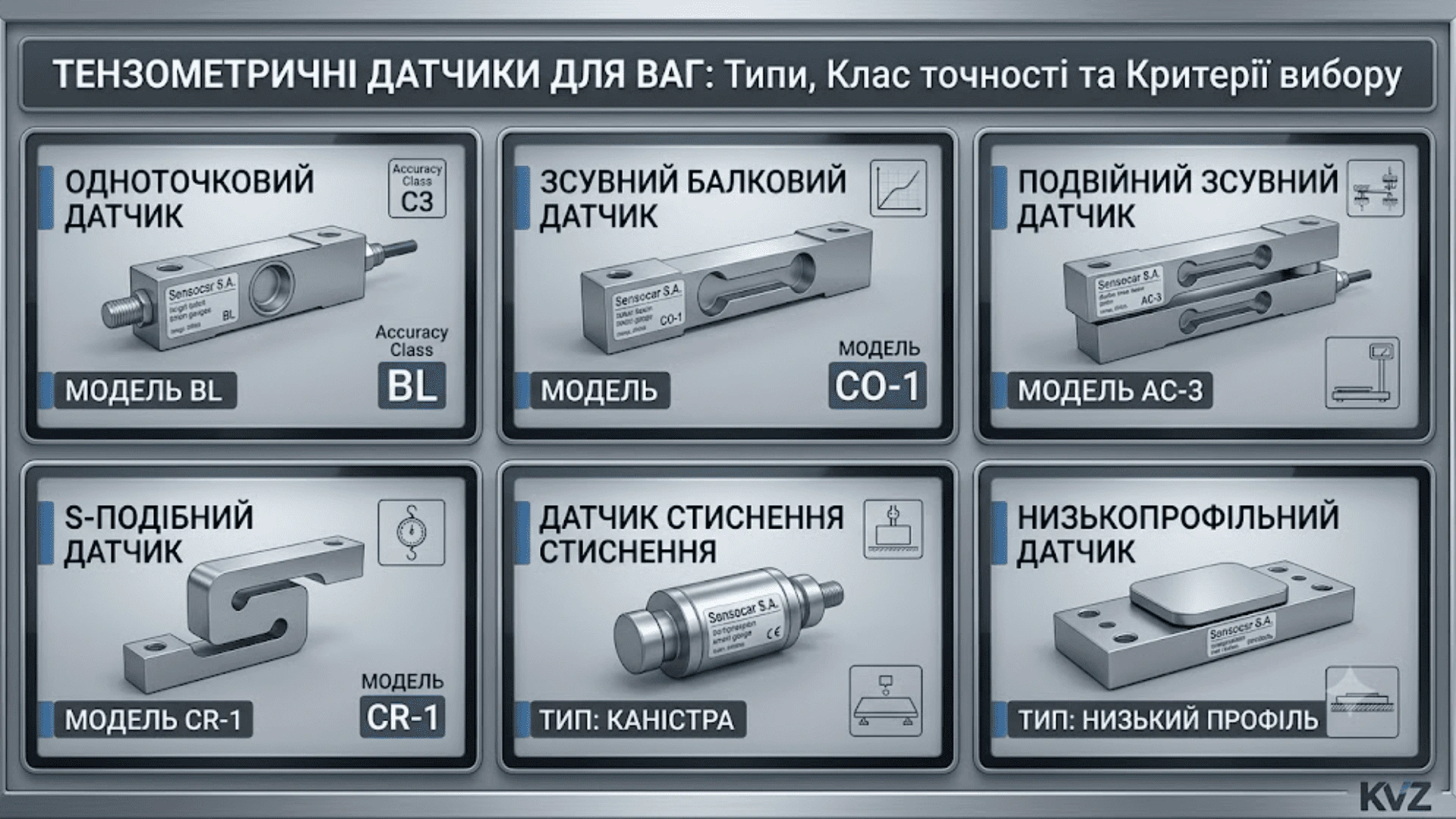
Main types of load cells:
single-point load cells — used primarily in platform scales and other compact weighing systems where accurate measurement must be maintained regardless of where the load is positioned on the platform;
single-ended beam load cells — used in platform, hopper, batching, and other industrial weighing systems;
double-ended beam load cells — designed for significant loads and suitable for heavy-duty weighing systems;
tension/compression load cells — measure forces under tension or compression and are used in specialized weighing and industrial systems;
column-type load cells — designed to handle large vertical loads and can therefore be used in heavy-duty weighing systems;
special-purpose load cells — used for non-standard applications that require a special design, installation method, or specific measurement range.
These are the main categories represented in the Sensocar Ukraine catalog. The specific type and model of load cell are selected by engineers according to the scale design, maximum weighing capacity, required accuracy class, and operating conditions.
Choosing the correct design affects not only measurement accuracy but also the service life of the entire weighing system. Therefore, already at the design stage, KVZ engineers determine the type, quantity, accuracy class, and characteristics of the load cells according to the specific weighing system and its future operating conditions.
The choice depends on more than just the maximum weight of the load. It is necessary to consider the direction of force application, the number of support points, scale design, possible shock loads, vibration, environmental exposure, and accuracy requirements. This is why, when developing weighing equipment, KVZ selects the type of load cells individually for each project. This approach makes it possible to obtain not merely compatible components, but a system that maintains measurement accuracy and operates reliably throughout its entire service life.
| Weighing intervals, t | Scale interval | Maximum permissible error during conformity assessment (after verification), kg | Maximum permissible error during operation, kg |
| from 1 to 25 t inclusive | 50 kg | ± 20 | ± 50 |
| over 25 to 100 t inclusive | 50 kg | ± 50 | ± 100 |
| over 100 to 150 t inclusive | 50 kg | ± 75 | ± 150 |
| Weighing intervals, t | Scale interval | Maximum permissible error during conformity assessment (after verification), kg | Maximum permissible error during operation, kg |
| from 0.4 to 25 t inclusive | 20 kg | ± 20 | ± 40 |
| over 25 to 60 t inclusive | 20 kg | ± 30 | ± 60 |
| over 60 to 100 t inclusive | 50 kg | ± 50 | ± 100 |
| over 100 to 150 t inclusive | 50 kg | ± 75 | ± 150 |
| Weighing intervals, t | Scale interval | Maximum permissible error during conformity assessment (after verification), kg | Maximum permissible error during operation, kg |
| from 0.4 to 25 t inclusive | 20 kg | ± 20 | ± 40 |
| over 25 to 80 t inclusive | 20 kg | ± 30 | ± 60 |
| over 80 to 100 t inclusive | 50 kg | ± 50 | ± 100 |
| over 100 to 150 t inclusive | 50 kg | ± 75 | ± 150 |
| Weighing intervals, t | Scale interval | Maximum permissible error during conformity assessment (after verification), kg | Maximum permissible error during operation, kg |
| from 0.4 to 25 t inclusive | 20 kg | ± 20 | ± 40 |
| over 25 to 60 t inclusive | 20 kg | ± 30 | ± 60 |
| over 100 to 150 t inclusive | 50 kg | ± 75 | ± 150 |
When selecting a load cell, it is not enough to consider only its maximum load capacity. Understanding the main parameters helps avoid mistakes when choosing equipment and ensures the required weighing accuracy.
The main characteristics of a load cell include maximum load capacity, accuracy class, scale interval, output signal type, housing material, and degree of protection against dust and moisture. These parameters determine the accuracy, stability, and reliability of truck scales.
Load cells for weighing equipment are manufactured in various countries, including China, EU countries, and the United States. In practice, sensors from different manufacturers can be used if their technical characteristics meet the requirements of a specific weighing system. At the same time, KVZ recommends using high-quality European-made load cells. In particular, the company works with equipment from the Spanish manufacturer Sensocar, represented in Ukraine through Sensocar Ukraine.
Based on the type of output signal, load cells are divided into analog and digital models. Analog load cells transmit an electrical signal to the weighing indicator for further processing, while digital solutions provide digital data transmission and may offer additional diagnostic and weighing system monitoring capabilities.
Another important parameter is the load cell accuracy class. For truck scales, C3, C4, and C5 classes are most commonly used, depending on the accuracy requirements and configuration of the weighing system. KVZ recommends and installs C5 load cells, which provide high measurement accuracy and stable equipment operation under intensive use.
When selecting a load cell, the operating conditions of the scales must also be taken into account: maximum load, traffic intensity, temperature, humidity, and dust exposure. For outdoor operation, a high degree of enclosure protection is particularly important. For example, the Sensocar product range includes models with IP67, IP68, and IP69K protection ratings.
Each individual parameter is important, but they should only be evaluated together. For example, a high accuracy class cannot compensate for insufficient moisture protection, while a large safety margin will not ensure stable operation without proper temperature compensation.
A comprehensive analysis of all characteristics makes it possible to select a load cell that best matches the operating conditions. When designing weighing systems, KVZ engineers consider all these parameters simultaneously, helping to ensure measurement accuracy, reliable equipment operation, and long service life even under intensive use.
Selecting a load cell begins not with searching for a specific model or manufacturer, but with analyzing future operating conditions. The same load cell may perform perfectly in laboratory scales but be completely unsuitable for a truck weighing system or hopper system. Therefore, the selection process must take into account not only the technical characteristics of the load cell itself but also the specific features of the entire weighing system.
The first step is to determine the maximum load that will be applied to each support point. It is important to consider not only the weight of the load but also the weight of the structure itself, possible dynamic loads, uneven weight distribution, impacts when vehicles enter the platform or when a hopper is filled, as well as the effects of wind or vibration. This is why load cells for industrial weighing systems are selected with a certain safety margin during the design stage.
Choosing the correct load cell design is equally important. For example, beam or single-point models are generally used for platform scales, while column-type or diaphragm load cells capable of handling heavy loads are more commonly used for truck and rail scales.
Special attention must be paid to operating conditions. If the equipment will operate outdoors, in areas with high humidity, significant dust levels, or aggressive environments, the load cell must have an appropriate protection rating. For most industrial facilities, models with a protection rating of at least IP67 are recommended, while IP68 is preferable for particularly demanding conditions.
The housing material also affects equipment durability. Aluminum load cells are well suited for lighter systems, while alloy or stainless steel provides better resistance to mechanical loads, corrosion, and temperature fluctuations.
Another important criterion is the accuracy class. For most commercial and industrial scales, class C3 is sufficient, although sensors with higher metrological characteristics may be used in specialized systems.
If a system uses several load cells, they must have identical technical parameters, sensitivity, and electrical characteristics. Even minor differences between individual sensors can negatively affect measurement accuracy and make calibration more difficult.
Metrological documentation should not be overlooked either. A high-quality load cell should be supplied with a calibration certificate and technical documentation confirming its characteristics and compliance with applicable standards. This is particularly important for weighing systems used for commercial transactions.
In practice, selecting load cells often requires comprehensive engineering calculations. KVZ specialists perform these calculations during the weighing system design stage, taking into account the equipment type, number of supports, nature of the load, and operating conditions. This approach ensures measurement accuracy, minimizes the risk of sensor overload, and extends the service life of the entire system.
Many people believe that the main component of a weighing system is the platform or electronic indicator. In reality, it is the load cells that determine how accurately the entire system will operate. A mistake during the selection stage can lead not only to deterioration in metrological performance but also to premature equipment failure.
One of the most common problems is incorrect selection of the rated load. If a load cell operates close to its maximum capacity, even minor overloads or shock loads can cause irreversible deformation of the elastic element. As a result, readings become unstable and measurement accuracy gradually decreases.
Another common mistake is using load cells that do not match the scale design. For example, installing beam-type models in systems where the primary load is intended for column-type load cells leads to uneven force distribution and accelerated equipment wear.
In practice, KVZ specialists have also encountered cases where load cells with insufficient protection ratings were used outdoors. Moisture, dust, or aggressive substances gradually damage internal components, resulting in unstable readings or complete system failure.
Problems may also arise due to incorrect installation. Platform misalignment, uneven loading of supports, inadequate grounding, or failure to comply with cable installation requirements can negatively affect even high-quality load cells.
Another mistake is cutting costs on components. Using cheap load cells of questionable origin without verified metrological characteristics often results in increased measurement errors, calibration difficulties, and a shorter service life of the scales.
In most cases, these problems can be avoided during the design stage. This is why weighing equipment manufacturers perform comprehensive selection of all system components rather than selecting individual parts separately. When developing weighing systems, KVZ takes into account the platform design, location of support points, nature of the load, and operating conditions, ensuring stable equipment operation even under intensive use.
A load cell cannot be considered separately from the entire weighing system. Its characteristics must correspond to the platform design, support type, weighing indicator, electronics, and equipment operating conditions. This is why the best results are achieved through a comprehensive approach in which all components are selected and configured by a single manufacturer.
Kyiv Weighing Plant has been developing and manufacturing industrial weighing systems for companies across various industries for more than 10 years. During the design process, the company’s engineers take future operating conditions into account, perform the necessary calculations, select the optimal load cells, and ensure their correct configuration. This approach provides not just a set of separate components, but a reliable weighing system with predictable accuracy and a long service life.
Signs of a malfunction may include unstable readings, significant deviations when repeatedly weighing the same load, calibration errors, or a complete absence of signal. For accurate diagnostics, specialists check the zero balance, insulation resistance, integrity of the strain gauge bridge, condition of the cables, and the sensor’s output signal.
For most truck, platform, hopper, and rail scales, C5 accuracy class load cells are the optimal choice. For high-precision laboratory or specialized systems, sensors with higher accuracy classes may be used.
The IP protection rating determines how resistant the enclosure is to the ingress of dust and moisture. If the scales operate outdoors or under conditions of high humidity, aggressive environments, or heavy dust exposure, an insufficient protection level can damage the sensor and cause measurement errors. For most industrial facilities, models with a protection rating of at least IP67 are recommended, while IP69 is recommended for particularly demanding conditions.
Yes, but the new load cell must fully match the sensors already installed in the system in terms of rated load, accuracy class, sensitivity, electrical characteristics, and design. After replacement, calibration and inspection of the entire weighing system are recommended to ensure correct load distribution and measurement accuracy.
An excessive safety margin is not always an advantage. If the rated capacity of the load cell significantly exceeds the actual load, its sensitivity may be insufficient to achieve the required measurement accuracy. The optimal option is determined based on engineering calculations.
For long-term and stable operation, load cells must be installed correctly, overloads should be avoided, proper grounding of the weighing system must be ensured, cables should be protected from mechanical damage, and regular maintenance should be performed. It is also important to use load cells whose characteristics correspond to the actual operating conditions and to carry out equipment inspections and calibration in a timely manner.
