

23 july 2026
Truck scales have long ceased to be merely equipment for determining the weight of a vehicle. For a modern enterprise, they are a tool for logistics control, inventory accounting, and minimizing financial losses. This is why they are used by agricultural enterprises, manufacturing companies, logistics centers, quarries, construction companies, and other businesses where freight transportation takes place every day.
Truck scales are specialized weighing equipment designed to determine the total weight of a vehicle or the load on individual axles. They are most commonly used to control the receipt and shipment of products, maintain commercial records, verify vehicle compliance with permissible weight limits, and automate logistics processes.
Modern weighing systems can perform far more tasks than simple weighing. They can be integrated with ERP and accounting systems, automatically generate reports, store weighing history, work with RFID vehicle identification, and integrate with license plate recognition systems. In this way, truck scales become a fully integrated part of an enterprise’s digital infrastructure.
The primary purpose of truck scales is to ensure accurate control over the movement of material resources. They help enterprises obtain reliable data on the quantity of raw materials, finished products, or bulk materials entering or leaving the company’s premises.
For most companies, truck scales solve several important tasks at once:
Truck scales are especially important for enterprises with high freight traffic. When dozens or even hundreds of vehicles leave a facility every day, even a minor weighing error can result in significant financial losses. This is why modern weighing systems increasingly operate in a fully automated mode, minimizing operator involvement.
Truck scales are used in virtually every industry where raw materials, materials, or finished products are transported. Their versatility is explained by the fact that weight control is an important component of production, logistics, and financial processes.
In the agricultural sector, truck scales are used to account for grain, sunflower seeds, corn, rapeseed, animal feed, and other products. At grain elevators and storage facilities, they make it possible to accurately determine the volume of harvested crops received and control shipments.
In logistics companies, weighing equipment helps verify that vehicles are loaded correctly before departure, monitor vehicle compliance with regulatory requirements, and automate freight transportation accounting.
Construction companies, quarries, and building material manufacturers use truck scales to control the weight of sand, crushed stone, soil, cement, and other bulk materials. This makes it possible to maintain accurate product records and avoid disputes with customers.
At industrial enterprises, truck scales provide control over incoming raw materials, the movement of materials between production areas, and the shipment of finished products. For the food, metallurgical, woodworking, and chemical industries, such systems have long become a standard element of production accounting.
Customs terminals, transportation hubs, and large logistics complexes should also be mentioned separately. At these facilities, weighing equipment helps verify whether the actual weight of cargo corresponds to the accompanying documents and provides additional control over vehicle flows.
This is why modern truck scales are designed for specific operating conditions. For an enterprise, it is important not simply to purchase equipment but to obtain a solution that takes into account traffic intensity, site characteristics, maximum loads, and future automation requirements. Kyiv Weighing Plant implements exactly these types of comprehensive projects — from selecting the optimal design and engineering the foundation to installation, commissioning of the scales, and subsequent maintenance support. This allows the customer to obtain a weighing system that will operate efficiently for many years and meet the actual needs of the enterprise.
Read more about this topic in our article “Truck Scales for Enterprises: Applications in Different Industries.”
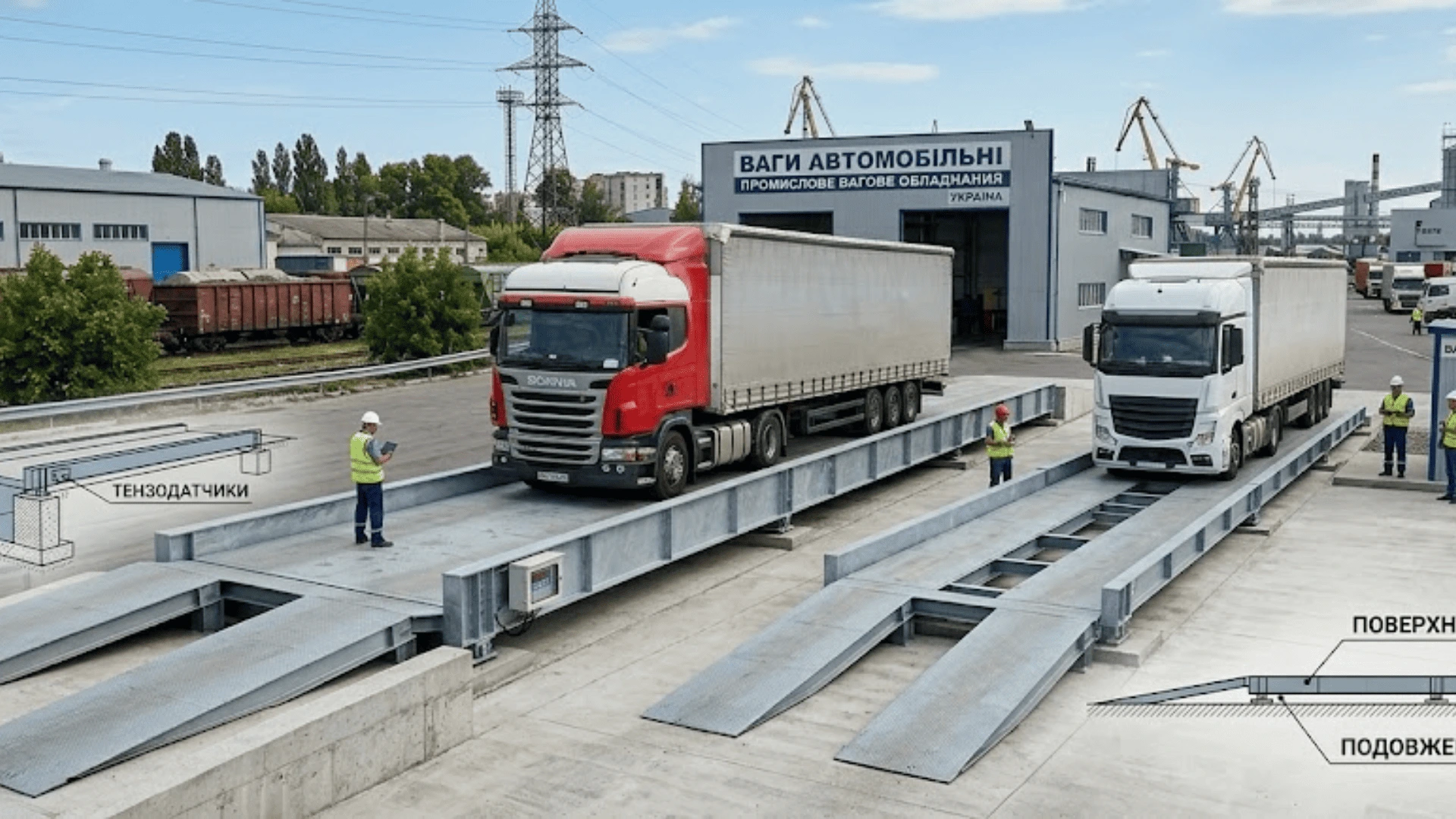
Truck scales are a complex system in which each component contributes to measurement accuracy and uninterrupted equipment operation. Although different models may vary in design or installation method, the basic structure of modern weighing systems remains the same.
The main components of truck scales are:
The platform receives the load from the vehicle and distributes it evenly to the load cells. It can be made of steel or reinforced concrete. The choice of material depends on operating conditions, traffic intensity, and the enterprise’s budget.
The platform length is also selected individually. Shorter structures are sufficient for smaller trucks, while platforms up to 24 meters long are used for road trains. An incorrectly selected platform length can complicate the weighing process or even make it impossible.
Load cells are the “heart” of the weighing system. They receive the mechanical load from the weighing platform and convert it into an electrical signal.
The accuracy of the entire system directly depends on the accuracy class, manufacturing quality, and correct installation of the sensors. This is why manufacturers pay particular attention to protecting them from moisture, dust, temperature fluctuations, and mechanical loads.
Signals from all load cells are transmitted to the junction box, where they are combined and then sent to the weighing terminal. This allows the system to operate as a single unit even when a large number of sensors are used.
The weighing terminal receives signals from the sensors, performs mathematical processing of the data, and displays the weighing result. Depending on the model, it can maintain an operation log, print documents, interact with peripheral equipment, or transmit information to the company’s corporate information system.
Modern truck scales are increasingly rarely operated as standalone systems. Most often, they are integrated with enterprise software that automatically records weighing results, generates reports, controls vehicle movement, and stores an archive of all operations.
Automatic license plate recognition cameras, RFID identification, traffic lights, barriers, and other automation systems can also be used, practically eliminating the human factor.
The operating principle of truck scales is based on converting mechanical load into an electrical signal. Despite the complexity of the equipment, the weighing process itself takes only a few seconds.
It usually consists of the following stages:
If a vehicle is weighed before and after loading or unloading, the difference between the two measurements determines the actual weight of the cargo. This is why truck scales are widely used in commercial operations, where even minor measurement errors can lead to significant financial losses.
With automated operation, the entire process can take place without operator involvement. Cameras recognize the vehicle’s license plate, the RFID system identifies the vehicle, the software generates shipping documents, and all results are immediately entered into the database.
Truck scales are classified according to several criteria. This makes it possible to select equipment that best suits the operating conditions of a specific enterprise.
According to the installation method, truck scales can be:
Pit-mounted models are installed flush with the ground surface and require less space for vehicle access. Above-ground structures are installed on the surface of a foundation and are easier to maintain. Foundationless solutions are used when a weighing system needs to be installed quickly or relocated.
According to the weighing method, truck scales are divided into:
Static scales provide maximum accuracy because the vehicle comes to a complete stop on the platform. Dynamic systems allow the vehicle’s weight to be determined while it is moving, which is especially useful for enterprises with high traffic volumes. Axle scales are used to monitor the load on each individual axle and help prevent overloading.
For modern businesses, truck scales have long been more than just measuring equipment. They help optimize logistics, reduce losses, and make accounting as transparent as possible.
The main advantages include:
It is equally important that a weighing system helps quickly identify discrepancies between actual and documented data and improves discipline among all participants in the logistics process.
Choosing truck scales should begin not with the price of the equipment but with an analysis of the enterprise’s production processes. There is no universal solution, because the requirements for weighing equipment at a grain elevator, quarry, or logistics complex will differ.
Before making a choice, it is recommended to assess:
It is also important to consider the enterprise’s future development. If freight traffic is expected to increase in the coming years, it is advisable to provide sufficient capacity for future system expansion from the outset.
Based on the many years of experience of KVZ specialists, most problems with truck scales arise not during operation but at the stage of selecting the weighing system.
The most common mistakes include:
In most cases, such decisions lead to additional expenses after only a few years of operation. It is much more cost-effective to choose equipment from the outset that meets the actual needs of the enterprise.
The quality of truck scales is determined not only by their design or components. Proper engineering, professional installation, metrological support, and subsequent maintenance are equally important.
Kyiv Weighing Plant has been developing and manufacturing weighing systems for the agricultural sector, industry, logistics, and other sectors for more than 10 years. Its own production facilities, engineering department, and installation teams make it possible to implement turnkey projects — from foundation preparation to official verification and commissioning of the equipment.
The company has already completed more than 2,500 projects throughout Ukraine, while an individual approach to each customer helps select a solution that is optimal in terms of both technical characteristics and economic efficiency.
Truck scales determine the total weight of a vehicle, while axle scales make it possible to measure the load on each axle separately. Axle weighing is especially useful for monitoring overloads and ensuring proper cargo distribution.
Static truck scales provide the highest accuracy because the vehicle comes to a complete stop during measurement. Dynamic systems operate faster and provide high throughput, but they are primarily used for operational control of vehicle flows.
Once a year is recommended. If truck scales are used for commercial transactions, they must undergo official verification in accordance with the requirements of applicable legislation. In addition, regular maintenance, inspection of load cell condition, and equipment calibration are recommended.
Yes. Modern weighing systems support integration with ERP, WMS, and accounting systems and can use RFID identification, automatic license plate recognition, traffic lights, barriers, and other automation components. This significantly reduces vehicle processing time and practically eliminates the human factor.
It is important to evaluate not only the equipment specifications but also the company’s experience, its own manufacturing capabilities, the ability to implement a turnkey project, maintenance services, and warranty obligations. A comprehensive approach helps avoid many problems during installation and subsequent operation of the weighing system.
