

23 july 2026
Truck scales operate accurately only when their installation site is properly prepared. Even modern equipment with high-quality load cells will not provide stable results if the foundation subsides, water accumulates on the site, or vehicles enter the platform at an angle. This is why choosing the right location should be considered one of the most important stages of the entire project.
The site determines not only the complexity of installation but also the future operating costs of truck scales. If the foundation or road surface becomes deformed, the load is distributed unevenly, which can affect weighing accuracy and the service life of the structure.
In addition, poorly organized logistics creates queues, makes it more difficult for heavy vehicles to maneuver, and increases the processing time for each vehicle. For agricultural enterprises, logistics centers, quarries, or manufacturing facilities, this means direct financial losses.
This is why it is advisable to assess the site before ordering the weighing system.
First of all, the geometry of the site should be assessed. It must have sufficient space for the platform, access roads, and safe vehicle maneuvering. It is advisable to choose an area that is as level as possible, since a significant slope increases the amount of earthwork required and the cost of construction.
The bearing capacity of the soil is equally important. If the ground is unstable, additional compaction or the construction of a reinforced foundation will be required. The groundwater level and the risk of flooding after heavy rainfall must also be taken into account.
Before construction begins, the site should be cleared of old foundations and construction debris and checked for underground utilities.
Vehicles should approach the truck scales in a straight line without sharp turns. The more steadily the vehicle moves before entering the platform, the more accurate the weighing result will be.
When designing the site, it is recommended to provide:
If the enterprise plans to increase freight traffic in the future, it is better to provide additional space from the outset for future logistics modernization.
The type of structure directly determines the site requirements.
| Installation Method | Features |
| Foundation-mounted | Maximum stability and durability; requires a concrete foundation. |
| Foundationless | Allows the scales to be commissioned more quickly but places higher requirements on soil conditions. |
| Pit-mounted | The platform is installed flush with the road surface; an effective drainage system is essential. |
The optimal option is determined after inspecting the specific site.
Water is one of the main factors that shorten the service life of a truck scale foundation. If proper drainage is not provided, the foundation gradually loses stability, while in winter there is an additional risk of deformation caused by soil freezing.
It is equally important to determine in advance where the power supply, cable lines, grounding, and automation equipment will be installed. If the enterprise uses an ERP or another accounting system, it is advisable to plan the integration of the weighing terminal, video surveillance cameras, RFID identification, and automatic vehicle traffic control from the outset.
Most problems arise before installation even begins.
The most common mistakes include:
All these factors can significantly increase the cost of the project after construction work has already begun.
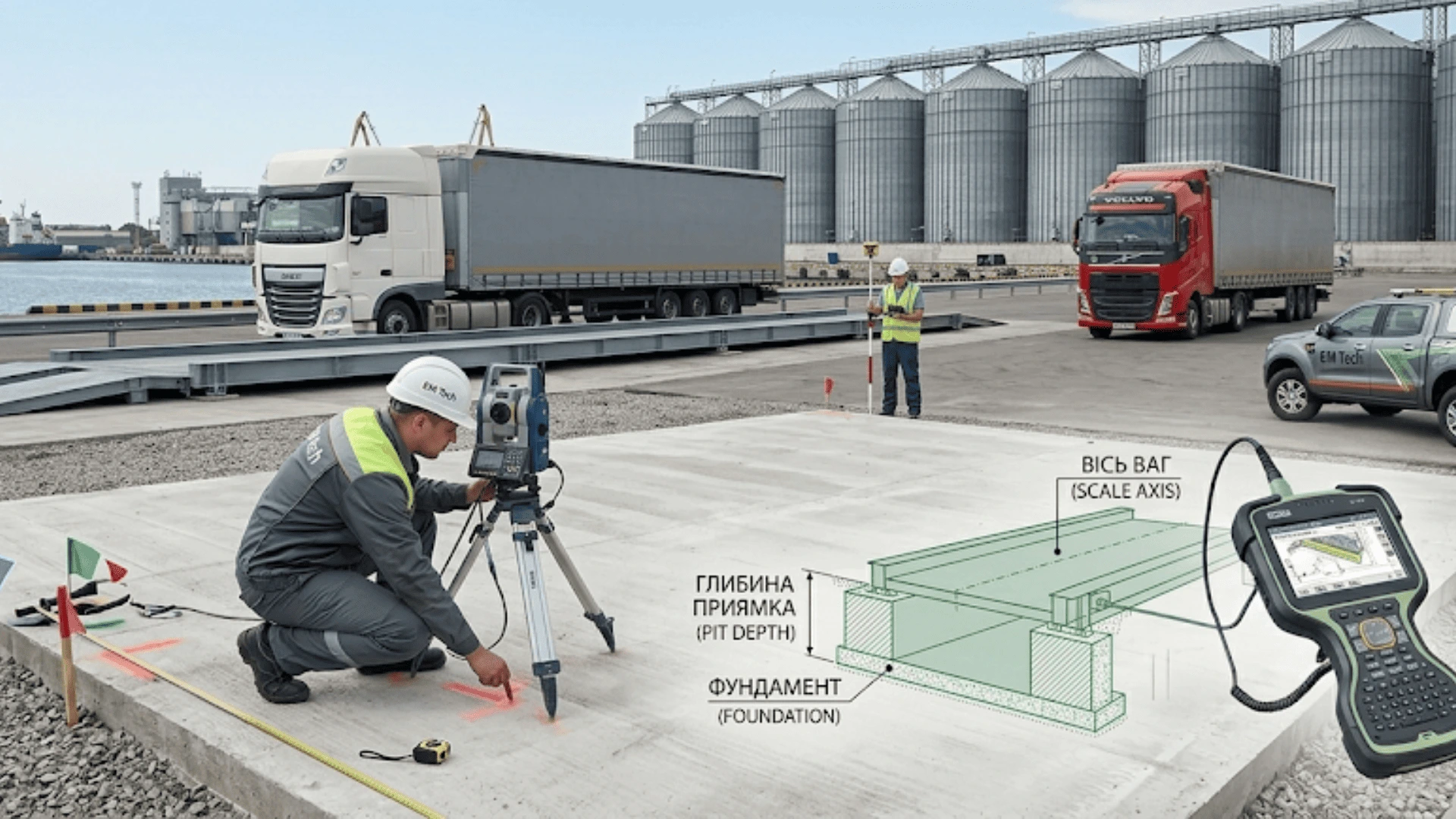
Before starting a project, Kyiv Weighing Plant specialists carry out a comprehensive site assessment. Engineers analyze the terrain, soil conditions, access roads, the feasibility of foundation construction, drainage, and equipment connections. This approach makes it possible to identify the optimal solution during the design stage and avoid unnecessary expenses.
KVZ has its own manufacturing facilities and provides design, installation, commissioning of weighing equipment, and official verification. As a result, the customer receives a complete range of services from a single manufacturer and can be confident that all components of the weighing system will operate as one integrated system.
Yes, if the scale design allows it. Foundationless models are installed on a specially prepared base or road slabs, which reduces the time required to commission the equipment. However, the feasibility of this installation method depends on soil characteristics, climatic conditions, vehicle traffic intensity, and the manufacturer’s recommendations. It is advisable to conduct an engineering site survey before choosing this solution.
Access roads should be straight and long enough for a truck or road train to enter the platform smoothly without making sharp turns. The more steadily the vehicle moves while entering the scales, the more accurately the weighing system operates. During the design stage, the required length of the access roads is determined based on the dimensions of the vehicles used at the enterprise.
Drainage protects the foundation and base of the scales from water accumulation, which can cause soil subsidence, structural misalignment, and a shorter equipment service life. This is especially important for sites with high groundwater levels or seasonal flooding. Properly designed drainage helps maintain stable weighing accuracy for many years.
Before installation begins, it is necessary to provide a power supply, grounding, cable routes, and a location for the weighing terminal. If the enterprise plans to automate the weighing process, network connectivity, video surveillance cameras, RFID equipment, traffic lights, and integration of the scales with an accounting or ERP system will also be required. Advance planning significantly simplifies installation and subsequent operation.
Ideally, specialists should be invited before construction work begins. An engineering site survey makes it possible to assess soil conditions, terrain, access roads, utilities, and other factors that affect the choice of scale design and foundation. KVZ specialists carry out this assessment during the design stage, helping to avoid unnecessary expenses, reduce project implementation time, and ensure reliable operation of the weighing system.
