

19 june 2026
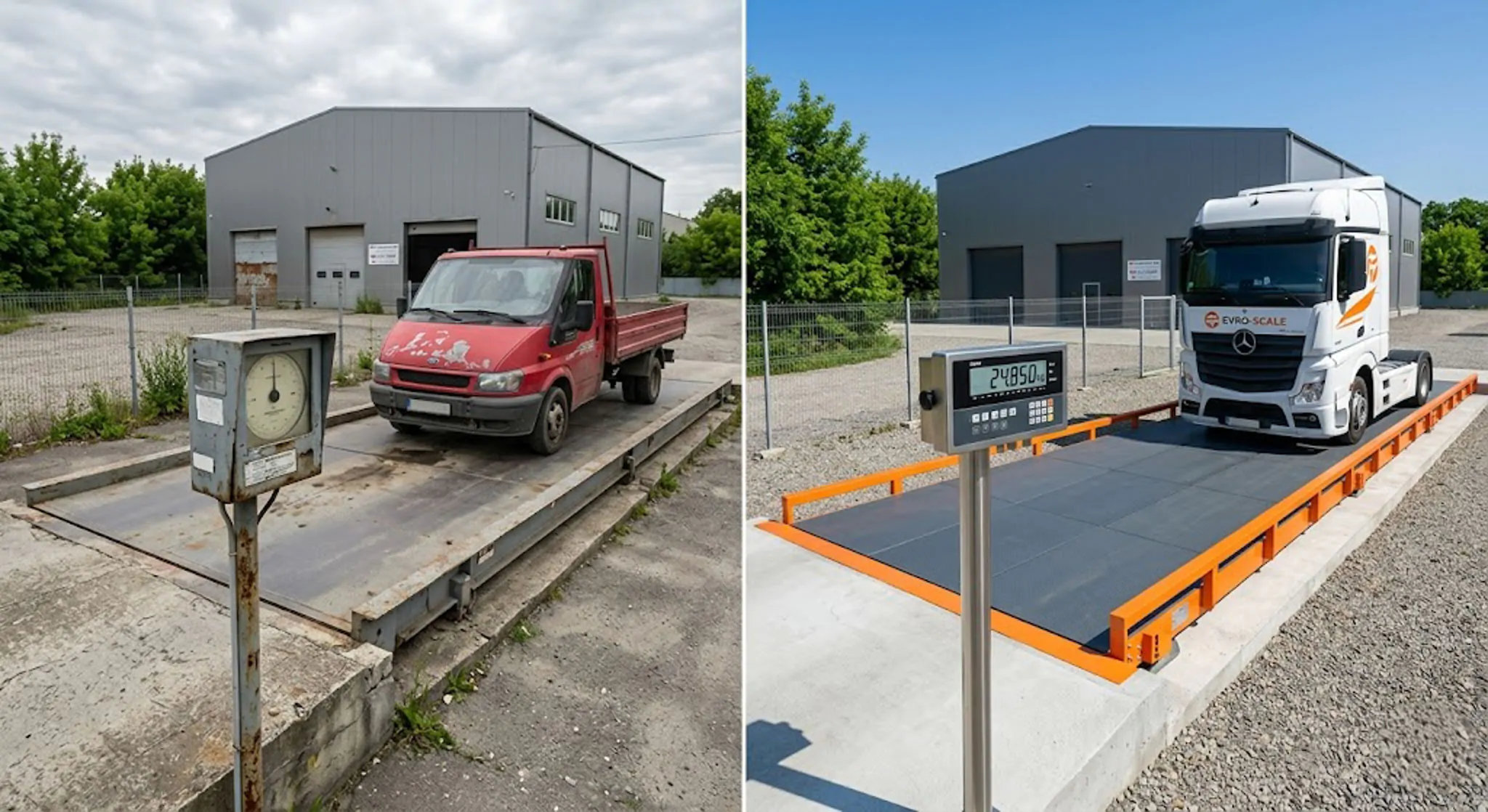
Accurate product accounting, efficient logistics, and a company’s overall profitability all depend directly on vehicle weight control. That’s why, sooner or later, weighing system owners face the question: upgrade the existing equipment or invest in a new solution? Let’s try to figure out under what conditions each of these approaches makes economic sense.
Over time, every weighing system experiences wear on individual components, electronics becoming outdated, and changing business requirements. As transport volumes grow or processes become automated, old weighing systems often can no longer keep up with the tasks at hand.
In this situation, making the wrong choice between repair and purchase risks losses, downtime, and inaccurate data. It’s easy to fall into extremes here – either spending money inefficiently on endless repairs, or prematurely writing off a functioning system.
To avoid making a mistake, you need to consider not only the wear of the scales but also your business expansion plans. Below, we’ll take a detailed look at when it makes sense to upgrade an existing system and when it’s better to invest in a new one right away.
As a rule, the need for weighing system modernization doesn’t appear right away, but builds up over time. Minor reading deviations show up first, followed by an increasing number of failures and repairs.
There can be several reasons:
If a business is actively growing, old truck scales can become a limiting factor for further growth.
Most often, the work concerns the electronic part of the system.
Modern truck scales can work together with video recording cameras, RFID identification, access control systems, and automatic document printing. Modernization may include:
Upgrading the equipment improves functionality without fully replacing the entire structure. Refitting and calibration of the systems are carried out by KVZ specialists, taking into account the specifics of the client’s production activities, logistics, and accounting policy.
Modernization makes it possible to gain modern functionality without significant capital investment.
Main advantages:
In many cases, truck scales achieve a level of accuracy sufficient for most production and logistics tasks after the sensors and electronics have been replaced.
Despite the obvious advantages, this approach has certain limitations. If the steel structure or foundation has significant wear, updating the electronics won’t solve all the problems. In addition, the capabilities of the old platform may limit the maximum load capacity and length of the weighing system.
Sometimes endless repairs turn into a permanent expense item, while achieving flawless weighing accuracy becomes increasingly difficult. That’s why the first and most important step is a professional technical inspection. KVZ specialists carry out this assessment to clearly determine whether the planned investment will be economically justified for your business.
Installing a new system doesn’t always make sense. It’s often more practical to restore the existing equipment.
This option is suitable if:
In such cases, modernization significantly cuts costs and quickly returns the system to full working order.
Sometimes restoration becomes economically unfeasible. In that case, it’s more practical to invest in a new system right away.
The most common reasons:
Modern truck scales can be custom-designed for a business’s specific needs, which is especially important for grain elevators, quarries, logistics centers, and large manufacturing facilities.
The Kyiv Weighing Plant carries out the entire scope of work – from design and foundation construction to installation and commissioning of the equipment.
Before making a decision, it’s worth comparing both options.
| Parameter | Modernization | New Scales |
| Cost | Lower | Higher |
| Implementation Time | 1–3 days | From several weeks |
| Accuracy | Depends on the condition of the structure | Maximum possible |
| Service Life | 10–15 years | Over 20 years |
| Scalability | Partially limited | Virtually unlimited |
| Automation | Possible | Full |
| Load Capacity | Depends on the existing platform | Selected individually |
The decision to upgrade or completely replace a weighing system affects not only the initial costs but also the business’s operational efficiency for years to come. The reliability of the equipment determines shipping speed, accounting accuracy, and the stability of logistics processes.
Modern solutions help reduce losses caused by measurement errors, avoid fines for vehicle overloading, and cut down on the number of manual operations. In addition, process automation helps reduce the influence of human error and simplifies control over the movement of raw materials and finished products.
A correctly chosen solution has a positive impact on return on investment, optimizes staff workflow, and provides room for further business growth. This is especially important for businesses where vehicle traffic intensity is constantly increasing.
The desire to save as much as possible doesn’t always produce the expected result.
Companies most often make the following mistakes:
As a result, truck scales can require constant repairs and create additional costs.
For the choice to be well-grounded, it’s worth systematically evaluating several factors.
Before making a decision, it’s recommended to:
A comprehensive approach helps avoid unnecessary expenses and select the optimal solution for many years to come.
Upgrading existing equipment is often the economically justified option. If the foundation and platform remain in good condition, replacing the sensors and electronics provides modern functionality without major investment. However, in cases of significant structural wear, increasing loads, or the need for full automation, it’s more practical to install new truck scales. This solution offers a longer service life, high accuracy, and room for future scalability.
Specialists at the Kyiv Weighing Plant will help assess the technical condition of your equipment, calculate the economic feasibility, and select a solution that matches your business’s current needs and growth plans.
