

26 may 2026
Truck scales are widely used in logistics, agriculture, industrial production, and quarry operations, where they serve as an essential tool for accurate accounting and cargo flow control. The right weighing equipment directly affects operational speed, accounting accuracy, and prevention of financial losses. Experts from Kyiv Weighing Factory explain what should be considered before purchasing a truck weighing system.
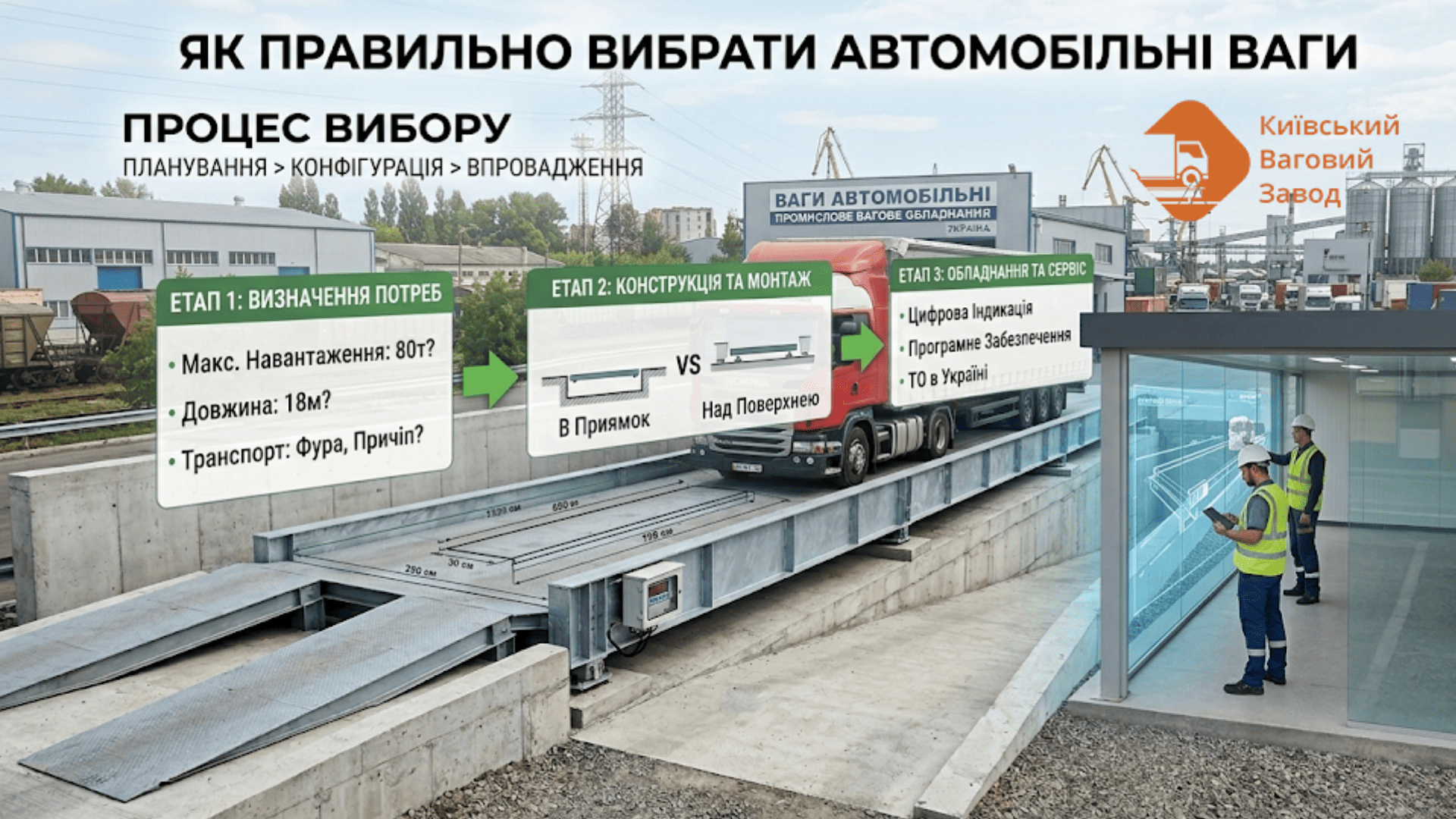
To ensure truck scales operate accurately, reliably, and without unnecessary maintenance costs, it is important to evaluate operating conditions, vehicle types, and business requirements before making a purchase. Below are the key steps that will help businesses select the right weighing system.
First, determine the tasks for which the truck scales will be used.
For commercial accounting at grain elevators, warehouses, or manufacturing facilities, static weighing systems are typically selected, where vehicles come to a complete stop on the platform. If the business needs to process a large flow of vehicles quickly, dynamic weighing solutions should be considered.
Operating conditions should also be taken into account. Simpler systems may be suitable for seasonal use or temporary sites, while intensive daily operation requires more durable truck scales with reinforced platforms and reliable foundations.
It is also important to evaluate future business growth. If increased traffic flow or heavier vehicles are expected in the future, it is better to choose equipment with additional load capacity and longer platform dimensions from the beginning.
The platform structure is the foundation of the weighing system, so its quality directly impacts equipment durability and weighing accuracy.
Reliable truck scales are manufactured from certified steel in compliance with production standards and strict quality control procedures. Key technical parameters include:
If the structure is not strong enough, platform deformation, settling, and measurement errors may occur over time.
For businesses with heavy traffic flow, it is especially important to choose truck scales designed for continuous high loads. That is why many manufacturers use reinforced beams, stiffening ribs, and additional protection against moisture and temperature fluctuations.
Modern truck scales differ not only in load capacity but also in platform design. The most common solutions are rolled steel structures and orthotropic platforms. Orthotropic platforms are lighter, highly rigid, and better suited for continuous vehicle movement.
The installation method also deserves special attention. Above-ground truck scales are mounted on the surface and require ramps for vehicle access. They are easier to maintain and faster to install. Pit-mounted systems are installed flush with the road surface, significantly saving space on the company’s site.
The platform material is another important factor. Metal truck scales provide fast installation and easier relocation, while concrete platforms are considered a more reliable solution for long-term operation and heavy loads. The final choice depends on operating conditions, vehicle type, and business budget.
Weighing accuracy is one of the key criteria when selecting a weighing system. Even the smallest measurement error can lead to financial losses, documentation discrepancies, and conflicts with suppliers or carriers. That is why truck scales must provide stable results regardless of workload intensity or weather conditions.
Several factors affect measurement accuracy:
It is important that truck scales undergo official calibration and comply with metrological standards. Kyiv Weighing Factory, a developer and manufacturer of weighing systems, always provides the required documentation and warranty for its equipment.
Service maintenance should also be considered. Regular inspection of load cells, cable connections, and software helps maintain system accuracy throughout the entire service life.
Maximum load capacity determines the amount of weight truck scales can handle without losing accuracy or risking structural damage. This parameter should be selected according to the type of vehicles that will regularly use the system.
For small trucks, models with capacities up to 30–40 tons are often sufficient. If the company works with semi-trailers, grain trucks, or road trains, truck scales with capacities of 60–80 tons are commonly used. Quarry machinery and oversized transport operations may require systems rated for 100 tons or more.
KVZ specialists recommend choosing equipment with additional load capacity reserves. This helps prevent platform overloading and ensures stable operation even if traffic flow increases in the future.
The weighing platform must match the type of vehicles being weighed. If the vehicle does not fully fit on the platform, measurement results may become inaccurate and the weighing process less convenient.
For standard груз vehicles, platforms with lengths of 16–18 meters are most commonly used. If the company operates road trains or long vehicles, truck scales with platforms up to 24 meters should be considered.
The platform material is also important. Metal platforms are faster to install and easier to transport, while concrete platforms offer higher durability and are better suited for intensive long-term operation. The final choice depends on operating conditions, load intensity, and business budget.
The foundation is the basis for stable operation of the weighing system. Proper foundation preparation directly affects measurement accuracy, structural durability, and operational safety.
Truck scales can be installed on monolithic, above-ground, or pit-mounted foundations. Above-ground structures are the most common because they provide convenient access to equipment and simplify maintenance. Pit-mounted solutions help save space on the company’s site.
When preparing the foundation, it is important to consider soil type, groundwater level, and drainage systems. Improperly prepared foundations may cause structural settling, negatively affecting weighing accuracy.
Load cells are among the most important components of a weighing system because they are responsible for measurement accuracy. Modern truck scales may use either analog or digital sensors, each with its own characteristics.
Analog sensors are generally more affordable and are often used at facilities with moderate workloads. However, they are more sensitive to voltage fluctuations, humidity, and external interference.
Digital load cells provide higher accuracy, support self-diagnostic functions, and allow faster detection of potential faults. In addition, truck scales equipped with digital sensors are easier to integrate into automated accounting and vehicle control systems.
It is also important to consider the protection level of sensors against dust, moisture, and mechanical damage. Businesses with intensive workloads should choose equipment with enhanced protection and higher durability reserves.
Automation significantly simplifies the operation of weighing systems and reduces vehicle processing time. Modern truck scales can integrate with accounting software, access control systems, RFID readers, and video surveillance systems.
Automatic storage of weighing results helps eliminate manual data entry errors and simplifies reporting. This is especially important for businesses with heavy traffic flow, as it speeds up documentation processing and reduces queues on site.
In addition, automated truck scales help monitor vehicle movement, record license plate numbers, and store weighing history. This increases operational transparency and minimizes the risk of errors or misuse.
Many modern systems also support remote monitoring and data transfer to the company’s internal ERP system, making accounting processes even more efficient and convenient.
For stable and safe operation of the weighing system, it is important to properly arrange the installation area and implement additional protective measures. Truck scales should have reliable grounding, protected cable lines, and a stable power supply system.
Cables must be protected from moisture, mechanical damage, and temperature fluctuations. It is also recommended to install wheel guides or barriers to help position vehicles correctly on the platform and prevent structural damage.
For businesses operating 24/7, it is advisable to equip truck scales with lighting, traffic lights, and video surveillance systems. This improves vehicle movement safety and simplifies monitoring of the weighing process.
Another important factor is regular maintenance. Inspection of sensors, cable connections, and software allows timely detection of faults and helps maintain measurement accuracy for many years.
Choosing truck scales depends not only on the technical characteristics of the equipment but also on the reliability of the contractor responsible for system design, supply, and commissioning. Mistakes at this stage may lead to inaccurate measurements, operational downtime, or additional maintenance costs.
First of all, it is important to evaluate the manufacturer’s experience and the availability of completed projects in various industries such as agriculture, logistics, and manufacturing. A reliable company should have its own engineering base, design department, and the ability to adapt solutions to specific site conditions instead of offering only standard configurations.
Another important criterion is the availability of a full-service approach — from site inspection and foundation design to installation, system configuration, and official calibration. This approach minimizes risks and ensures correct scale operation immediately after commissioning.
It is also necessary to assess service quality, warranty conditions, and technical support availability. A reliable contractor does not simply sell equipment but ensures its stable operation throughout the entire lifecycle.
An example of this approach is Kyiv Weighing Factory, which operates as both a manufacturer and integrator of weighing systems. The company delivers turnkey projects, offering not only equipment manufacturing but also foundation preparation, installation, system setup, and commissioning. Thanks to its own production facilities and engineering team, KVZ can adapt solutions to specific business needs and provide support throughout all implementation stages.
